Showing posts with label Theory/Design. Show all posts

Tuesday, November 29, 2011

Avoiding Monsters in OD&D

At the risk of going over some well trod territory, I thought I’d share some notes I’d jotted down as something worthy of investigation - The section entitled Avoiding Monsters in the Underworld and Wilderness Adventures book (volume 3 of the original D&D booklets). The rules laid out there are very specific - some of them I’ve used and some of them I haven’t (probably since I originally started playing with Moldvay’s rules). Now that I play S&W: Whitebox, it’s interesting to more closely examine the beige books’ idiosyncracies.

One item of note is that monsters in OD&D will automatically attack and/or pursue unless their adversaries are obviously stronger and the monsters would know better. This is versus Moldvay, where some monsters always act in the same way and attack, but the reactions of most vary: “The DM can always choose the monster’s reaction to fit the dungeon, but if he decides not to do this, a DM may use the reaction table…”

So basically, Moldvay says “Use your best judgement” whereas OD&D says “Monsters are monsters - their raison d’être is to attack you. If it was otherwise, they’d be potentially dangerous animals or perhaps intelligent beast-men. We’re not on a zoological expedition kids, we’re monster hunting.

Also, Moldvay has a Reaction Table but OD&D has a Random Actions by Monsters table. In Moldvay, the monster might even become your friend! In OD&D, the monster might respond positively to something, but we can still assume that it wants to kill us. This seems contradicted by the inclusion of neutral and lawfully aligned creatures listed in Monsters and Treasure (volume 2). Maybe those should just have been listed separately as “Other, Non-human Beings."

One might conclude at least a couple of things from this reading: First, that OD&D as written is decidedly more hack and slash. Second, that there isn’t as much moral ambiguity in OD&D as there is in later editions. Maybe it was the fact that the game was becoming popular with kids and criticisms were being raised at the time that led to these particular rules being revised. Nobody wants to be accused of teaching children that there are intelligent beings not worthy of moral consideration precisely because they don’t consider you worthy of moral consideration (they just want to kill you). But…that’s just what monsters are - that’s what they do.

Maybe all subsequent hand wringing about goblin baby killing could have been very easily avoided if the term "monster" had simply been better defined. Or maybe it’s not that easy... just easier to let the dice be the judge.

Wednesday, November 16, 2011

The Yogi: A New Class for Swords & Wizardry

For a while now I've tossed around the idea of a PC class that is explicitly non-violent or that derives experience from things that aren't related to combat or treasure. I'm not wholly convinced that such a class can work in the game, but I think offering it as an option to players might be an interesting experiment and a way to coax perhaps otherwise reluctant players to join. Uncomfortable with bashing in skulls? Try the Yogi class! I can see some serious humor potential there. Also, since writing up the Yellow Order of Freyse, I've been thinking about how a player might actually want to join it and how that would work.

So, I submit here the Yogi class - nothing too complicated, but certainly very different from every other D&D class. Some qualifiers - the "yogi" as cultural phenomenon is open to many interpretations. Why should the one here be so ascetically oriented? What about the karma yogis, or bhakti yogis - not to mention such "chaotic" yogis like Milarepa? Well, I had to limit the scope of possibilities to keep it simple and in line with the lightness of the OD&D/SW:WB rules. Creating a number of subclasses of the Yogi sounds tempting though...

The Yogi Class for S&W Whitebox

The yogi (or female yogini) is concerned with three things: overcoming the illusionary and temporary nature of normally perceived reality, freedom from desires and attachment which lead to suffering, and reconnecting and merging with the source of all creation.

While most yogis respect and observe devotional practices associated with one or more deities, some worship none - or else just ambiguously refer to an omnipotent and omniscient God, Creator, or Spirit. What distinguishes yogis from clerics is their belief in the practice of ahimsa, or nonviolence, and also that their salvation depends primarily upon their own willpower and mental focus rather than faith in supernatural beings.

Yogi Advancement TableCharacter Class Abilities and Restrictions:

Yogis must begin as lawful in alignment and remain so or else lose the special powers given to them.

Possessions: Yogis are severely limited in the amount of possessions they may have - they may never possess more than what they can carry on their person, they avoid contact with gold or jewelry, and may not carry more than the equivalent of 1 gp worth of other types of treasure. They may not use magic items.

Weapon and armor restrictions: Yogis practice nonviolence - they are forbidden from using any weapons. They shun the use of armor or shields, believing that these encourage the use of weapons and threat of violence. The DM will have to be creative in awarding the yogi PC experience points - deeds which produce “good karma” for the character or party are suggested as an alternative to experience gained in combat or through treasure. Another option might be experience granted after successfully carrying out missions under a guru's direction.

Spell casting: A Yogi gains siddhis, or mental powers which correspond to some cleric and magic user spells. In order to obtain these, the yogi must spend one hour in meditation per spell, per day.

The following siddhis may be chosen:

• All cleric spells except spells against Law and the following: Hold Person, Sticks to Snakes, Insect Plague, Quest, and Raise Dead.
• Magic user spells: Read Languages, Detect Invisibility, Knock, ESP, Levitate, Darkvision, Fly, Protection from Normal Missiles, Water Breathing, Wizard Eye, Contact Other Plane, Passwall, Telekinesis, Teleport, and Anti-Magic Shell.

In addition, at 3rd level the Yogi may Simulate Death, lowering his heart beat and body temperature, and appearing not to breathe. This state can be maintained for d6 turns per level, once per day.

Saving Throw: Yogis receive a +3 bonus on saving throws vs. poison and paralysis.

Banishing Undead: Yogis can use their holiness to “Turn” the undead, causing them to flee. They do not require the use of a holy symbol for this purpose.

Charisma Bonus: At 2nd level and every level thereafter, Yogis add 1 point to their charisma score, up to a maximum score of 19.

Obtain devotees: At ninth level, the Yogi will attract a large number of loyal followers who will swear fealty to the character and wish to do good deeds in his or her name.

Experience Bonus for Wisdom and Intelligence: Wisdom and Intelligence are the prime attributes for Yogis. However, due to the Yogi’s restrictions against combat and treasure, these will only be used to calculate experience bonuses if the DM decides to codify specific examples of activities that generate good karma and to use these for experience point calculation. In that case, Yogis with both Wisdom and Intelligence scores of 15 or higher receive a 10% bonus to experience.

Saturday, October 15, 2011

Baseball, Board Games, and D&D

Right around the same time I was getting into role playing games, my older cousin was getting into Strat-O-Matic. Basically, you roll d6’s and consult player cards for the result of the at-bat. There are rules variants depending on how complex you want it to be, and of course you can play solitaire. To get a sense of it, you can try out a flash version of an at-bat here (just click the green circle to get started quickly).

I haven’t really played the game in decades - I’d like to, but don’t have a copy - probably it's only something hardcore fans would be interested in playing… or maybe gamblers. The prediction accuracy is excellent, allegedly having a batting average variance of only .015% (.007% for homerun average). Of course, that would be for last season, so its value for the current one is arguable.

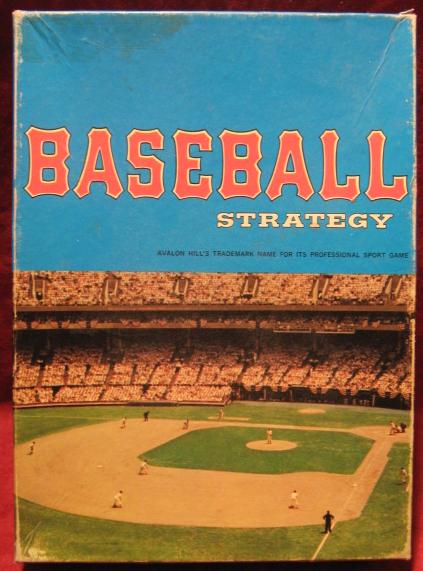
Strat-O-Matic has its competitors, the most popular of which might be APBA. Avalon Hill also produced baseball board games. Way back in ’62 they came out with Baseball Strategy. It uses “Fast Action” cards instead of dice to randomly determine outcomes. I recently picked up a much later version that AH released in 1980. Here are some scans if anyone's curious.

I’ve been been tossing around some of my own ideas for a baseball board game - admittedly much less simulation and much more gonzo. It’s a mash up of D&D and basic baseball rules, something I call Goblinball. I first began thinking about it when I attempted to improvise a game during one of our regular S&W sessions. That didn’t quite go the way I’d expected when the party brazenly attacked the hitter and catcher and all hell broke loose from both bullpens. I'd expected that to eventually happen, but hoped there’d be some bets and baseball drama first (bad calls, taunting, hit by pitches, etc.)

What’s interesting to me about the process of trying to hack them together is realizing how much they already remind me of one another. There’s the battle between pitcher and hitter, with each side “rolling” to see if they succeed against the other. There’s the saving throw of the defensive players who must catch the ball or tag the runner out, or perhaps dexterity checks on either side to accomplish their aims (or skills if you must).

The flow of a baseball game reminds me of D&D. A typical game can last hours, and occasionally goes longer than anyone expected (without a set end time). The storytelling is something like each person briefly becoming a radio broadcaster and relaying the game action. The DM is both pitcher and umpire, throwing the group various curveballs. I like how everyone has their own moment to shine when at bat; each individual describes his character’s action and makes a combat or other type of roll. When the party is in the field, they’re shouting defensive information and advice.

Describing and simulating actions in baseball and D&D also seem similar because of the limits of the field of play itself. In baseball, you can’t stray from the running lane and must move through the bases to score. It’s exactly this structure that makes the game easier to simulate. We don’t need to explain how the player goes to first, the player just indicates what his move is and we both make assumptions. He doesn’t have to describe every step - we both understand that there’s only one place to go and that the critical move was made a moment ago. The pitch and bat swing is analogous to the “What does your character do?” and “I do this.” exchange. In other words, it’s a linear, storytelling game.

Compare this for example to soccer (another game I enjoy)… Imagine describing the action in detail here. Sure it can be done, but it's painful: number 14 receives the ball, she dribbles 10 feet west, turns 30 degrees and moves a few feet forward, now back 4 feet, etc. The playing field is literally a field, whereas the baseball field is a field of probability and a track.

Hmmm, maybe I’m not describing that quite right. How about this: the randomness and uncertainty of a soccer ball or player’s location at any given moment is much higher than what can similarly be found in baseball. It’s this greater certainty principle in baseball that allows us to better design tools to simulate and measure the actions that happen there. D&D is a more linear game, based on the nature of back and forth discourse that moves the action forward. We aren’t all moving forward together in that field, we’re generally waiting for one described action to inform the next.

Just some pre-beer/game thoughts - in closing: Go Tigers!
Update: Facepalm.

Wednesday, July 27, 2011

Alternatives to Capitalism in Our Games

The rules of D&D operate under the assumption that the economy of the game setting is more or less like the real world’s - that the PCs’ culture values money, and in fact really revolves around it. Acquiring it is one of the primary character motivations, and it’s directly connected to gaining experience and leveling up. But what would D&D look like if we stripped this component out of it and replaced it with something else?

I started thinking about this last year when considering an island hopping campaign with the PCs being fairly “primitive” natives, rather than typical D&D characters from a medieval and European background. I was reminded of it later when I thought about running D&D in a prehistoric or ice age setting, and then again more recently when I thought about what it would be like to play solely as Native Americans or some kind of equivalent, in a world where Europeans never show up and technological innovation is glacial.

What would we use to replace the monetary system that we’re so familiar with in our games? Is D&D even the same game if we remove that, or are we playing something else with certain D&D mechanics?

Barter isn't unknown to those other cultures, and there would definitely be items with greater value due to relative scarcity. Take for example a good horse. Also, things tend to wear down quickly - so new furs need to be acquired and successful hunting takes time and isn’t guaranteed.

Rarer and more valuable still would be those things that have a symbolic value and are dangerous to obtain. The scalp of an enemy, for example. Or perhaps something similar to an eagle feather, instead derived from a monster. I’ve explored this just a bit in my current games, with monsters themselves being the treasure (see Claude de Sarlat, monster eater) - though in that case they’re commodified by being turned into gold pieces when sold to Claude’s chef. A better example might be the Makemanu, undead parrots whose feathers of different colors might easily fill in for gold, silver, and copper.

One issue with using these kinds of replacements is that they likely aren’t anything that can be hoarded, or rather, nobody in those cultures would want to do such a thing. In a hunter/gatherer or early agrarian society, what does one need to amass wealth for? Food to last a winter or in case of crop failure maybe, but not excess wealth - of what use is too many sheep? They’re just more difficult to guard and one can only eat so much mutton. But if there’s no giant treasure hoard, how am I to build a castle or establish a guild? My end game is buggered.

In these pre-capitalist societies, probably what’s more important is your status within the tribe - how high up on the totem pole you are. There may be beads and trinkets traded, especially with outsiders, but it seems like people of stone age cultures would be much more aware of the transitory nature of life and possessions (and place a greater value on relationships accordingly). Defending family and tribal honor, earning a good reputation amongst the tribe, or spiritual interests might all stand in as game incentives. Maybe the end game is helping the tribe find the perfect, peaceful, and fertile valley - maybe level progression involves achieving certain tasks and overcoming enemies that prove one’s bravery and honor without the need for shiny metals.

Looking back now, when I started playing D&D as a kid, I had all the time in the world. Marathon late night sessions could easily happen with friends staying over. I think a part of the game’s appeal was in the adult-like aspect of our characters having responsibilities and jobs (albeit as monster killers), as well as our ability to manage sums of their imaginary money - to spend as we saw fit without any parental supervision. Now that I’m older, I wonder if my interest in playing in a D&D world where money doesn’t figure so prominently hinges on the real life pressure of having to earn and manage it. Playing a caveman protecting the clan from cave bears and not worrying about paying for medical insurance or taxes on a castle would occasionally be a pleasant diversion.

Tuesday, May 24, 2011

Our Monsters Beget Monsters

Today I’ve been thinking about how monsters came into being in my campaign setting. My favorite monster creations always seem to grow out of Man - whether they're simply a man acting monstrously, whether they transform into a monster and back into a man, or whether they go over to the other side all the way and permanently become a monster in every respect.

This makes perfect sense since monsters are imaginary by definition, thus they come out of Man consciously or unconsciously. It’s the latter source that’s of most interest to me, since I think it can help steer my game into places I’d like to explore more. Though not a monster himself per se, take for example Claude de Sarlat, the monster eater. This is an NPC who was himself an adventurer, but through a twist of fate, now seeks to eat those monsters that would formerly have eaten him. Turning the tables like this and then stepping back even further, I can see that Claude is an expression of myself, a part of me that’s trying to find out what makes monsters tick, and what my own fears are, then explore them, digest them, and use them in the game somehow. Hopefully with the help of my players and for everyone’s entertainment. As I’ve said before, it’s not that I want to turn the game into a therapy session - just that I think we can plumb some very interesting places for game fodder.

Claude is an example of a man who turns into a kind of monster by his proximity to them - like the good detective who goes bad, becoming an addict and accomplice to murder while trying to root out organized crime from the inside. Another creation of mine, a kind of ape I wrote up, comes into existence when a man consumes a kind of fruit and transforms into the monster. It might seem funny and maybe obvious to others, but only a while after I wrote it did I see certain interpretations and its possible inspiration.

Sometimes a monster is just a generic monster. Like maybe orcs are just ugly, evil men really - generic pigmen. But maybe our game can benefit and we can learn something about ourselves at the same time if we step back and try to see why we choose to use certain monsters in our games - not when we just need a certain hit dice, but why a certain monster really speaks to us. And also why creating our own monsters and thinking about why we molded them in a particular way is such a fun and interesting endeavor. It might help us to role play a monster better, or to create more compelling or frightening ones. I suppose this is why I don’t like the idea of a random monster creator - for me, a monster needs to be greater than the sum of its parts. I like to know where a monster is coming from, and the seemingly random generator upstairs isn’t really so random - it just appears to be at first.

Approaching monsters from another direction then, what if I was to proceed from an understanding that all monsters are just debased and devolved men? Absurd! How can a purple worm once have been a man? It’s not easy to see the monster for the man sometimes, I have to admit. In this case, originally, a spineless man of enormous power and appetite? The doppleganger - a race borne of trapped liars. The basilisk - a self-loathing person with looks to kill? Well, yes, that’s the medusa too. Maybe the mythic underworld causes dungeoneers’ disease - being locations of concentrated evil, they poison those that visit them too often or that become trapped in them for too long. The effect causes even the sanest, most lawful and good people to eventually turn into monsters themselves, each a kind of monster based on their own unique character flaws, and into never before seen monsters if these flaws are unique enough. I suppose some of those so cursed then created other monsters, or bred with them. And so our monsters beget monsters…

Anyhow, thanks for letting me ramble a little here. I wanted to be working on a dungeon for tonight’s game when I started jotting down some ideas and sidetracked myself.

Tuesday, May 10, 2011

TSR's The Book of Marvelous Magic

A while back I picked up a copy of TSR’s supplement AC4 “The Book of Marvelous Magic”on eBay. I couldn't remember ever seeing a copy when I was a kid, and was interested to see the state of the magical arts back in 1986. AC4's a cornucopia of offbeat magic items that might provide some inspiration for creating your own items that fall into the “miscellaneous” category. I suspect Gygax and Mentzer went alphabetically through the dictionary for ideas for some of these. Eye catching entries from the table of contents include anchor, awl, bench, buckle, button, canoe, cleat, desk, fan, fork, gaff, hinge, inkwell, jug, kite, log, muzzle, oar, pitchfork, rake, rudder, slate, sundial, tent, tub, xylograph, yoke, and zither.

I’m trying to recall what my weirdest magic item creation ever was back in the day but drawing a blank. I think I was pretty conservative, probably to maintain any appearance that I knew what I was doing. More recently I’ve written up (and posted here) flags, undead bird heads, masks, a conch, a fruit, and a candle snuffer among other things. The snuffer I later discovered had already been written up in AC4, more or less... of course the supplement has several kinds of snuffers to boot.

There’s more than just a couple of arguably silly items found in this book. Here's two that have accompanying illustrations… (paraphrasing)

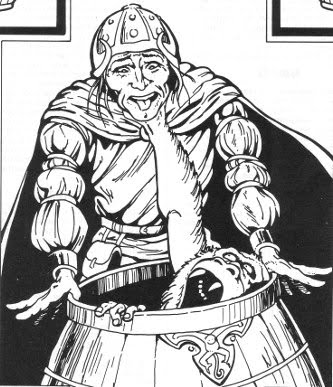
The Barrel of Monkeys
This item both contains an albino ape as well as polymorphs anyone looking into the barrel into an albino ape. Also, albino apes will continue to pop out of the barrel every turn until there’s a hundred of the things. It’s not clear here whether they disappear back into the barrel (or into thin air) once everything and everything nearby has been torn asunder. Or maybe they go on to live fruitful lives of mindless destruction forever after. The barrel loses its power if moved, but not if you move it telepathically. Since it’s not clear where the apes go, and also not clear if when a second person looks into the barrel whether another hundred white apes appears, this thing might very well be a weapon of mass destruction.

Wheel of Burning
Dude should have been wearing his Britches of Coolness

There’s this wagon wheel which, when commanded, throws Light ahead of the wagon on which its mounted. But unlike the harmless Wheel of Lighting, the Wheel of Burning will turn on you if anyone enters the light itself that’s been projected - then you'll feel its wrath! The light it projects will shift to become centered on the vehicle and then start to burn any creatures there. Hence the picture above.

So what's your favorite mundane magic item that you wrote up or that your DM threw at you?

Wednesday, April 6, 2011

Prison Scenario

In trying to devise some in-town adventure scenarios, I came up with the idea of a prison riot. The mistreated petty thieves, smugglers, and a murderer or two awaiting trial or execution manage to escape and take over the building where they were imprisoned. Barricading themselves inside, holding hostages as well as some good crossbow sniping positions from the upper levels, they might hold off a massive counterattack from the town’s militia. Maybe the poor choice of the prison’s location, close in to other buildings, is also hampering efforts to retake it. Then there’s the evil magic user still in solitary confinement - the other prisoners are scrambling to find the hidden key that would free him in order to gain his aid.

The idea came to me while thinking about Boot Hill and old western movies actually. I like the idea of the bad guys taking over a town, or at least making a lot of trouble in it, and the party, as newly deputized lawmen, having to retake control.

I’m not sure how much fun it would be though - it sounds a bit more like a war game scenario than one for role playing. I can see a lot of tactics being discussed, and magic used to work around the barricades and somehow gain entry. I’d want to create some sympathy in the party for the escapees too - maybe one of them really is innocent (“I was framed I tell ya!”) and the party uncovers some kind of high level corruption.

It might be better suited to slightly more experienced PCs than our current crew, which are all first and second level. I’ll post a follow up if anything comes from it. I'm a little bummed that work and dealing with taxes have been keeping me from giving any real attention to the hobby or blog lately, and the last two sessions of our usual weekday game were canceled too.

Monday, March 21, 2011

The Mysteries of a Religious Order

I've been buying old JG stuff on eBay again lately, and recently read Steve Marsh’s article in The Dungeoneer #15 (1980) entitled “Initiates of the White God”. He describes an initiation process where each level comes with its own expected sacrifices and rewards, as well the revealing of an esoteric mystery related to the order. Presumably these would vary widely from one order to another (although perhaps all expressing the same fundamental truths).

For example: “Level Four is the step to the first mystery. This mystery is that there is no mystery but that all mysteries are but common knowledge in the proper context. The Nach Lan is performed (similar to the Mithrian baptism of blood only with water) and one gains the responsibility to aid those in distress…” and “One becomes +1 vs. all evil creatures (both to offense and defense).”

I’m not so keen on introducing broad mechanical bonuses like this. I can see the temptation, especially if there are strict requirements that might take away some of the player’s freedom to choose their character’s actions. Instead, I’d prefer to introduce more flavorful rewards and restrictions with some restraint. For example, rather than a permanent +1 to attacks and AC, perhaps the order rewards a magic weapon. The PC might have one already, maybe even a better one, but still be expected to use it. Such a gift might also fail them, should they act in a manner unbefitting their level of initiation. It could also be lost or broken, and its recovery or mending become an adventure seed itself. An example of a minor reward might simply be an open invitation to the orgy pit of the high priestess at the main temple. Oh frabjous day! In any event, the symbolism of such a gift or reward should be of importance and relevant to the particular order.

I thought it would be a good idea to ready something similar for our own game. Below is a rough draft of Agnal’s potential initiation progression. He’s a cleric in our Dordogne campaign who somehow fell into worshipping the unlikely “Corrno, God of Thieves” (as found in JG’s “The Unknown Gods”). It seems odd having to devise an initiation progression like this for an order of a deity so explicitly connected to a class of character in the game, but that was what the player wanted.

Marsh’s progression starts at first level and completes at nine. Ours starts at second (since our clerics usually don’t have a deity or spells until then) and finishes at ten. Bear in mind that level progression in our Swords & Wizardry game is very slow.

Initiates of Corrno, God of Thieves

Level 2: Naivette
Level 3: True Membership
Level 4-6: Mysteries 1-3
Level 7: Questing
Level 8-10: Mysteries 4-6

Level Two: The naivette is expected to respect thieves above others. Their company should be sought out, and they should be the first to be healed should the occasion arise. Opportunities to steal should always be kept watch for - and brought to the attention of trusted confidant thieves. Theft should always be (prudently) encouraged, and Corrno brought to the attention of thieves as the proper choice of worship. In return, Corrno may enter the initiate’s dreams and provide clues to the existence of nearby wealth that’s ripe for plunder.

Level Three: At this level of initiation, the initiate will be visited by higher ranked members who will demand to know how he has thus far supported Corrno and his worshippers. They’ll present to him a gold offering plate (which is actually only gold plated) as a symbol of his recognition as a true member. At this level he’ll be magically bestowed the knowledge and use of Thieves Cant. He’s now expected to visit thieves guilds during his travels when the opportunity arises, in order to procure converts and donations and to provide various services.

Level Four: The First Mystery of the Order is revealed: Someone is always stealing from you, and you are always stealing from someone else. This is unavoidable truth - understanding it deeply is the first step in acquiring true wisdom. At this level, the initiate is expected to attempt to help imprisoned thieves - by acting as counselor, healing them of injuries sustained during capture, or even (occasionally) in forcibly liberating them. In recognition of attaining this level, the order symbolically gifts the initiate a Bag of Holding.

Level Five: The Second Mystery of the Order is revealed: Property is to be respected - It is best to take someone else’s property, that it might be better respected. The ability to pick locks and pockets as a first level thief is attained (though this ability will not improve). Along with their other regular duties, the cleric is now expected to occasionally travel and contact initiates of the third level for interrogation (and to steal from them).

Level Six: The Third Mystery of the Order is revealed: Everyone has property in his own person - his life. This too, shall be stolen. At this level a cleric of Corrno gains the back stabbing ability of low level thieves (it should be mentioned that clerics of Corrno are already allowed the use of edged weaponry). However, his charisma is lowered by one point as his continual connivance and scheming becomes written into his facial features and more difficult to hide.

Level Seven: Questing. At this stage of initiation, the Council of the Fifth Mystery will require the initiate to undertake a quest of its choosing. All worshippers of Corrno must give aid to a questing initiate of the order if so asked, else they risk the order’s confiscation of all their possessions and possible execution.

Level Eight: The Fourth Mystery of the Order is revealed: Property is Theft: There is no such thing as theft because there is no such thing as property. At this level the initiate is no longer allowed to possess coinage, non-magical jewelry, or gems. When obtained, these must all be given over to the Council of the Fifth Mystery and the Order as soon as practically possible. However, if large sums are money are required, the Council may be petitioned.

Level Nine: The Fifth Mystery of the Order is revealed: Truth is the property of no one.  All possessions other than ragged clothes, magic items, land, or structures are to be given away (but made to appear as though they’ve been stolen). An initiate of this level is a member of a council which dictates what quests are to be assigned and to whom, among other business.

Level Ten: The sixth mystery of Corrno is inexpressible in written language. These initiates no longer serve as council members. They’re said to take orders from Corrno himself.

Thursday, February 10, 2011

Or maybe my game is weird.

Role playing games are a great place for people to explore their emotions and thoughts around the subject of right and wrong. There’s the safety of being able to rob, kill, or perhaps worse, without negative real-life legal, physical, or other consequences. Or conversely, of being able to stop a bully, and to discover dignity or integrity. Either way, the feedback from other players and from the referee creates a kind of microcosm of society, with the real world’s ethics usually entering and informing the game’s imaginary stage.

The situation is a bit different with children though, as their understanding of the real world’s ideas of right and wrong are not as based on personal experience as an adult’s, nor have the norms of their culture necessarily been fully accepted or even understood. It makes perfect sense that children would use the tools available to them through role playing games to question and test these norms.

Most readers (being players) know these things intuitively, and how rpgs encourage critical thinking. All of which I mention because I’ve been slowly realizing how the area of the game that most interests and entertains me these days is precisely in moments of moral ambiguity. Whether I use a complicated device or magic item, an encounter with kobolds, or an eccentric NPC, I’ve found myself (often unconsciously at first) creating situations that highlight the uncertainty of the moral ground the PCs are standing on.

I’m not sure if that makes my game weirder than someone else’s or if I’m just more focused on and fascinated by this type of thing. I’ve been out of the hobby for two decades before taking an interest in it again a couple of years back. Maybe it’s this long absence that’s making me aware of the difference between the games of my youth and my games today - or maybe there isn’t all that much difference. There are the same goblins, kobolds, and wolves - what’s new is a greater awareness of the degrees of moral ambiguity and complexity, and subtler ways of introducing situations that force the players to examine these things. I think that whether I was running Traveller, some kind of Cthulu game, or Boot Hill for that matter, this is where my primary interest would lie.

(update: I should add "...while making sure we're having fun, of course.").

Thursday, December 30, 2010

Your Own Personal Deity, Part 2.

I’m still trying to work out a methodology for having the PCs’ deities communicate with them in a number of ways. Going back to the subject of dreams (there’s still omens, visions, and voices to consider, among other things), the obvious choices to me so far were:

1. Occasionally announcing that a character remembers their dream. The players will assume that this announcement must have some larger meaning in the game, otherwise why mention it to them? The advantage with this approach is that we don’t spend a lot of time on the mechanics of actually having the dream and simply deal with its consequences in the game. The disadvantages are many though - we implicitly ignore an ongoing creative potential of dreams in the game as as source of confusion, inspiration, and spontaneity. I would think a medieval setting filled with monsters and magic would imply that characters there would be a much more superstitious lot than ourselves. They’d be more attentive to their dreams, particularly if they worshipped a god (or more than one) knowing that their dreams may be windows into other worlds. They’d also be more likely to share their dreams with one another for help in deciphering them.

2. A more methodical approach that involves randomly determining whether a character remembers their dream and/or randomly determining whether the dream really is of any consequence - a message of some kind from the gods. I say “and/or” because allowing for unremarkable (from the DM’s point of view) dreams to be remembered enlarges the role playing possibilities. Key to this is making mention of the characters’ dreams more often so that they’re seen as a regular feature of the game, rather than as a game hook suddenly dropped like a lead weight. Every time they wake up, they roll dice. Even then, a balance would have to be sought of course, so that the players don’t become overly suspicious or paranoid. I can see the fantasy setting deepening with the surrealism that the greater presence of dreams in the game would bring, but I wouldn’t want them to become a primary focus. It might be best to be open about why the players are rolling dice, and that just because they can remember their dream, it doesn’t mean that it’s a sign from their deity. Of course, the whole discussion so far implies that only those that have chosen a god can play this game within a game - not necessarily so. Sometimes gods or demons make the first attempt at communication.

This happened in our S&W game. We play with clerics having no magic at first level - at this stage they’re similar to mystics; spiritual seekers looking for direction. The cleric character named Agnal began to have dreams where he saw a swirling cloud of darkness. At first, he thought that the swirling dark mist of unknowing might be the actual form of a god he should worship. Eventually, he reached second level. His player expressed some interest in the gods of thieves. Later, in a departure from his regular dreams, the small form of Corrno stepped out of the mist, dressed in his ragged clothes but still somehow managing to awe Agnal and make a worshipper of him.

Since I want the abilities of clerics to include a greater likelihood and ability to communicate with the gods, I’m going to factor that into any random dream calculations. I was thinking something along the lines of any character being able to remember their dream by making a saving throw. This way, as they grow in experience they’ll have a better chance. Since the d12 is so neglected, we’ll use it for our dream rolls - if they make their save and remember the dream, on a roll of 1 in 12 the dream has significance and is some kind of a sign from a god. This chance goes up at each level for clerics, ie. 1-2 on d12 at 2nd level, and 1-9 at 9th level. In the case of clerics, any significant dream remembered is specifically from their god. The degree of the dream’s significance and its content will be entirely the DM’s prerogative.

This seemed all well and good until today when I hit upon the idea of the gods communicating via dreams in correlation to the PCs location and not just random chance. What if dreams were treated something like wandering monsters? In a pantheistic culture, gods have areas of interest and influence. Maybe their presence should be felt by PCs more easily in the kinds of places or situations that correspond to these areas. I could ditch my random chance roll in favor of this, or else I could modify the dice rolls when appropriate. Agnal sleeping across the street from a bank might cause him to be more likely to have a dream where Corrno somehow helps to reveal a key’s location - if only he can remember it when he awakens. Or perhaps if Agnal sleeps across from a bank he’s more likely to remember a dream by making his saving throw, but whether or not the dream is relevant will not be affected.

In the example given, I can see how tactics, role playing, and player discussion might be stimulated by the desire to more fully consider a situation where they find themselves. The benefits of worshiping a certain god might come into play and therefore a player’s more serious consideration when choosing one.

Though I’m tempted just to hand wave the whole thing and make rulings on the fly, I think if I can come up with a fairly quick dice rule about it, I’ll be more likely to take the various possibilities into consideration. The end goal will have been served - the players will be taking a greater interest in their gods and their relationships with them.

Tuesday, December 28, 2010

Your Own Personal Blipdoolpoolp. Part 1

Shifting gears a bit today, I thought I’d share how I’ve been wanting to develop a way to create and grow a player’s relationship with their PC’s deity, and to have a plan for this generally in my game. Initially, I wanted to do this just with clerics, but the more I’ve thought about it the more I can see opportunities for non-cleric PCs to have personal relationships with their chosen gods as well.

Towards this end (with apologies to any religious readers!), I first thought it would be interesting to examine delusional insanity, or "progressive systematized insanity". If I compared a character’s growing relationship with their deity using progressive insanity as a framework, I thought I might be able to extrapolate a usable outline for how to measure a PC's progressive ability to communicate with their gods (I know, a little crazy itself). If there was a fairly clear, symptomatic line, I thought I might be able to devise level breaks at which various things were possible. So for example, if only late stage loonies hear voices in their heads or experience full blown hallucinations, then correspondingly only very high level characters would have their god speaking or appearing to them directly in some manner. I’m no psychologist though, so if this is possible I’ll leave the task to someone else. Also, the fact that Joan of Arc was credited with having experienced divine visions as a petite fille of only 12 years old seems to deter any notion of PC level progression necessarily relating to the ability to commune with the gods.

I still think of Bruce Galloway’s take on all of this and how logical an approach it is to something so irrational. I had also hoped to standardize the ways in which communication between PCs and their gods occurs in order to set player expectations and hopefully meet their demands for fairness in such exchanges. Now though, I’m not sure that this is possible or even desirable. After all, the gods work in mysterious ways. Though not all gods are as fickle as those in the Greek mythos.

So stepping back from that goal a bit, it still might be useful to devise and prepare some techniques to convey the occasional message from above. The prerequisite to this, of course, is knowing how the gods speak to us, or rather, to our PCs. It seems nearly anything can be attributed to being a sign from above. It would be useful to outline a number of ways in which people have traditionally been said to experience communication from or even with their deity. I won’t presume to try and address the entire subject properly here - I’m just hoping to get the ball rolling by writing some ideas down and maybe stimulating some further thoughts of my own on the subject.

A subtle method of communication from a deity can be found in the form of a dream. Intangible and easily forgotten upon awakening, a dream allows for the possibility of divine communication in any of the more concrete forms found in a wakeful state and more. That is, a dream may be of a simple scene, a recreation of the days events, or a fanciful but possible future event. It can also be filled with fantastic or magical imagery.

The problem with dreams in our games though, is that merely mentioning to a player that their PC had a dream implies that it holds some meaning worth noting. This is the exact opposite of how we know dreams to work - that they probably don’t mean anything and that they’re certainly not worth mentioning to anyone else. Except perhaps to a shrink or lover. If I’m going to be using dreams as a resource in my game, it might be best to understand them as only worth mentioning precisely because they must be portentous.

I don’t like this. I would prefer a dream’s appearance in the game to not be so predictable, but the only way to mitigate the problem this sudden appearance raises would be to make reference to them more frequently, closer to how we experience them outside of the game. It could be a lot of fun, requiring myself to make sure that every so often I mention to a player what their PC dreamt last night. Oh the random tables I could make. The players might even begin to assume that all of their characters’ dreams have meaning. Maybe they’d be right - maybe all dreams do.

Tuesday, October 5, 2010

Fantasy Islands: The Excellence of X1

Though I didn’t get anything accomplished creatively over the weekend while vacationing, I did bring along my copy of TSR’s X1: The Isle of Dread. I’d been thinking about it lately because of its inclusion of dinosaurs and because of the island setting generally. Way back at Cavecon, I shared that I’d like to see and had been considering writing up an S&W based game or oceanic setting, not quite Ruins & Ronin but something like Polynesia meets Fantasy. Fantesia? Maybe seeing Grégory’s tank and dinosaur hybrids brought it up for me again.

X1 is jam packed with mini-adventures. Among many other things, it gives a nod to Haiti and zombie masters, has a roof-top village that reminds me of the wookie home planet or the moon of Endor, and has a partially flooded dungeon beneath a temple. Its dinosaurs brought to mind the Land of the Lost as a kid, but also King Kong. And of course, it has pirates. The need for the art of diplomacy might suddenly seem obvious to your players in an island setting like this, especially if it’s something they’ve never cultivated before.

As great as the module is in different ways, above all I think both as player and DM it brought to my attention just how compelling islands are as adventure settings. There you have the unknown in every way - do the natives speak our language? Are they friendly and what gods do they worship or magic know? What strange never before seen creatures or dangers may lurk there… Has civilization as we know it even reached it yet?

From a DM’s point of view, each island can be a campaign itself - their self-contained nature lends themselves to this. There’s no naturalistic urge to link one island to another in quite the same way as with mainland cultures, races, or otherwise. Like the potentially unique character of a dungeon, the island stands apart. Here we can find strange variations on the familiar, like giant creatures long since extinct on the mainland, or perhaps we’ll find a portal to another time, or alien technology or aliens themselves. Islands are like planets that way, just floating in space waiting to be explored.

Sunday, September 26, 2010

King Arthur in the Tomb of Horrors

In recently discussing the possibility of playing the Tomb of Horrors module as a one-shot, I suggested the idea that we use characters picked from Deities and Demigods just for kicks. Sure we could use the ones included in the back of the module, but I thought it might be interesting and a little humorous to see how someone like Sir Gawaine or the Gray Mouser might do down there. My friend declined, though mostly because he’d like to run his own characters through it one day never having played it before.

The conversation later had me thinking about what other quick and dirty gonzo one-shots I could come up with using the old 1st edition stuff. In retrospect, I can’t believe I didn’t do more of that kind of thing as a kid. I remember we did overrun the village of Hommlet with a high level thief and my friend’s assassin's guild, but that was more sadistic than gonzo really.

I can see mashing together some old stuff. Maybe you step through a door and are transported to a wholly different TSR module, then a few doors later, you teleport back to the original, or yet another one - a sort of 1st edition medley of modules that would really test the memory. Or perhaps to their surprise, all the inhabitants of one module are suddenly teleported and dropped into the various dungeon or rooms of another… G3 becomes S3. Running monsters as PCs and turning the table and having them invade various settlements would be fun. A handful of giants against the Keep on the Borderlands?

I’m committed to our regular games but these ideas would be a fun break for everyone, or something a potential new player might be interested in as a one-shot (lacking the ability to commit to a longer campaign). More than that, using the old stuff like this could give me the extra time I sometimes need for the regular game's design.

Sunday, September 19, 2010

Reincarnated PCs

I’ve only just now watched the latest Star Trek movie and it set some gears in motion (I haven’t been to a movie theater in six years!)… I’ve some mixed feelings about it, but it helped re-kindle the idea of running a game of classic Traveller for only one or two players.

In most RPGs I've played, when someone’s character dies, they’re pretty much born back into the game in the same time and space as their last character, or close to it. With only one or two players in a classic sci-fi setting though, the chance that they’ll die in a fantastic inter-planetary mishap or space-battle TPK is fairly high, in addition to the typical high mortality rate of an old school game. I’d like to try to run a campaign where the players experience the advance of history intuitively but directly through the advance of technology. So if they die, their next character won’t be born until their previous one might have lived out the potentially long life they would have had, this span being determined randomly by dice. When they “come back” the campaign world will have advanced slightly. They’ll be on their toes a bit more, not wanting to make assumptions about the current state of technology or extraterrestrial relations, and curious about the new options this state of affairs affords them and the impact, if any, that their previous lives might have had. I’d love to be able to guide the player(s) through a future history where their own planet first achieved interplanetary travel, had their first interplanetary war, and came to grips with the fact that various extraterrestrial species might have genetically interfered with their species evolution.

Taking a longer view of things, this might also mean that a player wouldn’t mind his character’s death so much. Campaign development would be more interesting and dynamic for everyone.

This was my first music purchase, the 45rpm b-side to "Whip It".

Thursday, September 16, 2010

Ghosts in the Game

Ghosts make their first appearance in AD&D, and were left out of the OD&D, Holmes, and Moldvay versions. In the Monster Manual, they’re powerful creatures indeed. Weighing in at 10HD, AC 0 (8 on the ethereal plane), they have a special attack of Magic Jar (a 5th level magic user spell) or of touch where their target ages 10-40 years when successfully hit. In addition, they can only be hit by magical or silver weapons (the latter of which only cause 50% damage). They can only by effected by magic spells cast from the ethereal plane, and any human or demi-human that they kill is “forever dead”. Presumably that means no Raise Dead, no Resurrection, no Reincarnation… no Wish? I think I read in 2nd edition that a Wish would work. Still, holy shit, huh? All of this is tempered by the fact that they can be turned by clerics… Of 7th and higher level. When I say 7th level, I mean with a roll of 20, although after that it does get easier quickly.

The MM’s description of its Magic Jar ability is not entirely clear to me. How often can they use this - is it “per the spell” as stated, implying once per day? The MM says that “if the ghost fails to magic jar its chosen victim, it will then semi-materialize in order to attack by touch…” So it’s not free to choose another opponent and try again? Maybe the supernatural effort to do so is too draining and that’s why the ghost has to materialize to attack in another way. Although it might be suggested that becoming tangible and visible would take supernatural energy as well, maybe even using more energy than just possessing someone’s body. Mentzer tries to clarify this a bit in the 1984 Companion Rules. There it states a ghost can use a magic jar effect, once per turn. Considering that the ghost would have the spell casting and general abilities and knowledge of the one possessed, it’s a formidable power however often it can be used.

What is this Magic Jar? It’s basically just good old fashioned possession, although the spell as written in the Player’s Handbook specifically involves the use of a large gem or crystal. This is where the spell caster first places his soul, or life-essence before eventually attacking and possessing someone. But why was the ghost’s power of possession written up this way? Are all ghosts inhabiting gems? That can’t be right. The MM describes them as “roaming about at night or in places of darkness.” Was using Magic Jar in its description just a way of easily referring DMs to a similar magic effect, and for brevity’s sake? Do I have to roll the ghost’s intelligence and wisdom in order to make the calculations listed under the Player Handbook’s entry for Magic Jar? The MM already says that they’re highly intelligent. Maybe Mentzer can clarify again. Back to the Companion Rules - he says this of their magic jar effect, “If successful, one item carried by the ghost will glow, powered by the life force of the victim. The ghost’s force then possesses the body of the victim and causes it to attack others. During this time, and for as long as it possesses another, the ghost’s figure stops, merely holding the light (but oozing the Ectoplasmic Net). The ghost and the item both remain ethereal.” Yeah. Ok, let’s look to a later edition - I just happen to have a copy of the 3.0 MM here. Ah, ghosts are now templates, and their power of possession is “similar to magic jar…although it does not require a receptacle.” Aside from potentially confusing things, a “magic jar” sounds a lot more innocuous than the Exorcist evoking “possession”.

Out of curiosity, I looked at Bruce Galloway’s interpretation of the ghost’s abilities in his Fantasy Wargaming book. Say what you will, but that book can provide a lot of perspective. Galloway says nothing about a ghost’s ability to possess someone, perhaps rightly assuming that only demons have this power. Instead, he refers to the ghost’s method of attack as its ability to frighten, period. This ability, depending on a number of factors, will either fail, cause a temporary loss in a character’s Bravery attribute, cause madness, or cause instant death. I like this, it’s very straightforward. Maybe it’s worth checking out yet another set or two of rules.

I looked at my (AH) Runequest’s ghost write up and see that there it engages in spiritual combat with intruders (it’s tied to a site or object). If it reduces its foe to zero magic points, it possesses him. Not surprising, but in a slight departure from the AD&D model, “usually causing the victim to kill himself.” I also looked at what Call of Cthulu has to say, and found my favorite entry thus far on the subject. “Each ghost should be crafted by the keeper to fit the circumstance of the adventure.” They may or may not be vulnerable to magic. They may or may not be exorcisable.

To many people, ghosts are real. More real to most people than ogres and orcs anyway. To me, that’s the appeal of using them in the game… they still stoke primal fears. The ghost and its powers also seem well suited to house-ruling the hell out of, or writing them up however you like. You might have to, depending on what game you play - there isn’t a ghost entry in the Swords & Wizardry rules, the 0e Reloaded Monster Book, or Labyrinth Lord.

Tuesday, September 14, 2010

Kids and Ghosts

So here's a question: Given that ghosts in AD&D/OSRIC age the people they touch by 10-40 years, if they touch a little kid, does the little kid stay the same size but just get older looking - like a freaky hobbit without hairy feet? Or do they suddenly actually grow in size and their clothes shrink and rip accordingly?

I mean, if their bodies grow, then there's a kind of polymorph thing going on and it just seems very odd or really fantastic somehow (of course, so is magical aging itself). Let’s say that physical growth does occur - might you end up with middle-aged adults whose language and demeanor is that of children? Another option with that approach might be that they’ll stop behaving like a child after a number of years go by that had originally been left to their youth, before it was stolen. Or would they magically and instantly advance in age and size and become the adults that they were destined to become in personality, simply missing the decades of life's experiences that they would have had? I suppose these other options might not be dependent on whether they grow in size or not.

I asked my wife and she chose the freaky hobbit option. She found the idea of a change in size to be silly, and in fact said that the child would not grow in size with natural aging either - that they’d be stuck in that small physical form for the rest of their lives. Crap. I don’t know why I hadn’t thought of that option. At least she indulges my occasional important question from left field.

I started to actually chart the possibilities to make a vote easier and to clarify it for myself, or even to have a table to roll on, but I just confused myself more in the attempt.

Personally, I like the idea of a more powerful ghost that robs children of their adulthood forever, but traps them in an adult body. It’s tragic, and makes for a good NPC.

Thursday, September 9, 2010

Assassinations 101

My new player has begun playing a PC (formerly an NPC) who’s an assassin. His guild is in the nearest large city to where the party has mostly been based: a smallish town with relatively minor problems. The assassin’s name is Gulch, and his background is that his superiors have sent him out into the world to raise funds to upgrade the guild’s headquarters.

This week's game was cancelled, and now I’ve got more time to prepare for the next regular session. I’ve been thinking that it might be great to do a one-shot solo adventure with this player in the interim. Gulch joined the party a bit late after other characters had died, so consequently he’s lagging in experience. I thought it might be nice to line up an assassination job for him to get him up to speed and this might be the right time to do it.

Player spoiler alert!


So I’m relishing the sinister possibilities… One idea I’ve had revolves around two NPCs in town. One merchant was stealing from another. The second merchant hired the party several sessions back to find out who was stealing from him. The group successfully captured the culprits, killing one in the process, both of whom turned out to be the sons of the first merchant. The surviving son is now rotting in a dungeon and the father (who claimed no knowledge of his sons’ activities) has travelled to the big city to hire an assassin to take out his competition once and for all and to avenge his sons.

My loose plan is to have one or two of Gulch’s minor superiors at the guild make a trip into town to check up on him, collect his dues, and assign him the task of killing the friendly merchant who’d previously hired him and his group. I’ve begun to think about the possibilities that the player might decline the job (and be punished by the guild), or that he might feel guilty and fail on purpose, or warn the merchant somehow. If the player takes the job, I have the task of drawing up the target's home, defenses, and daily routine to be prepared for the player beginning the stalking process. It’s all kind of morbidly fun to consider, though I suffer some minor guilt from, in effect, helping to plot the good merchant’s demise.

Because this is Gulch’s first job, and because he’s not yet proven himself, I’m very tempted to have the entire thing be a setup. That is, the two other guild members might have been sent to test Gulch. They may give him some help in plotting the kill, and then when the time comes, they might kill the merchant themselves. One of them might then disguise themselves as the merchant, and taking the proper precautions, pose as him for the planned event. Then if the player chickens out, warns the merchant, or otherwise screws up, he’s busted! All standard operating procedures for first time hits, of course. But will the player consider this?

If the player fails, he might be given a second chance, albeit one requiring even more brutality to succeed. If he succeeds, then I can see an ongoing series of solo games consisting of assassinations when our regular games don’t happen for whatever reason. That might get old quick, or it might not… Though the thief and assassin classes are well suited for solo-play, the thought of running one murder after another might be a little darker game than I’d want to play even semi-regularly.

I’d be interested in hearing about anyone’s fun or enlightening assassination experiences to be able to get some more ideas. From the game only, please.

Wednesday, July 14, 2010

Charisma and Magic

I’m really not a rules hacker, and am conservative with any tweaks I introduce, but something ChicagoWiz posted the other day got me thinking. Among other things, he proposed a “What if” where magic users were sorcerers and relied on charisma as well as intelligence. It’s a relatively neglected attribute that I’ve always wanted to give more attention. I really don’t want to overhaul the class, but the notion that charisma is taken into consideration with certain spells makes a lot of sense and makes me want to introduce it in my Swords & Wizardry games somehow.

Here’s a list of spells from the core rules that I’m considering combining with charisma in some manner:

MU: Charm spells, Monster Summoning, Suggestion, Conjure Elemental, Geas, Power Words
Cleric: Bless, Speak with (Animals, Dead, Monsters), Quest, Aerial Servant, Holy Word


The first thing that comes to mind is to simply use the typical attribute modifier with any saving throw a monster needs to make. This would be very modest - a +1/-1 thing. In the case of NPCs though, the difference in the spell caster and target’s charisma might be more fun, but it might also dramatically over or under-power the spell. That is, a 16 charisma spell caster casts Geas against a 10 charisma NPC. Forcing the NPC to save at -6 seems harsh. Maybe halving this and rounding makes sense, or I could always scale it somehow.

At first glance, it seems like a minor house rule. It’s a small group of spells where this would be used. I already use the 3d6 in order method for determining attributes, with no rearranging or re-rolls, so it would make overpowering spell casters less likely.

On the other hand, using charisma like this might add some extra flavor into the game and game balance be damned. It makes sense that a highly charismatic magic user would acquire and be predisposed to use spells that depended upon his personal magnetism, just as an ugly witch would have a harder than usual time in charming the rare visitor.

I think this is something that’s used to a degree in 3rd edition, but I’ve never played it and am not familiar with the rules. Has anyone done something like this (or more ambitious) with their own house rules in an earlier game version?

Monday, June 21, 2010

OD&D Castle Composition in Random Wilderness Encounters

There are at least four castles in the Dordogne setting I’m using - these are Beynac, Castelnaud, Commarque, and Fayrac. I’ve written here before about my interest in devising a method to stock them - I don’t require a high level of verisimilitude, but having something to base my attempts on would be helpful. The first example I thought of (as maybe most of us would) was the keep from B2. Erin at the OD&D Guild charted this nicely, but I thought for kicks I’d see what the old beige books had to say on the matter.

Volume 3, “The Underworld & Wilderness Adventures” has a table on page 15 with regard to the subject, entitled “Types of Guards / Retainers in Castle.” Granted, this table is for use with random wilderness encounters with castles, but for fun let’s roll on it to see what comes up.

I’m glad to see I’ll be rolling a d6 on it. First roll result = 4. “Necromancer.” This necromancer has a 50/50 chance of being hostile to the party should they pass within one hex (actual distance not directly stated) of the castle. The suggested map to use for something like this was Avalon Hill’s “Outdoor Survival” map - thanks to Thomas Denmark at Original Edition Fantasy for the best online image I could find of the map itself. Note Book 3 says that if you use this map, all of the indicated ponds you should actually assume are castles. The closest to one another I could easily see are only 3 hexes away. Sounds like it would work for my Dordogne map: a couple of pages later, scale is described: “Assume the greatest distance across each hex is 5 miles.”

The table becomes a bit more arcane at this point. I interpret it to mean that having rolled for a Necromancer to inhabit the castle, I should now roll d4 to see what special guards or retainers there are there. Result = 4 again, which indicates d12 Gargoyles. This result is footnoted with the number 12, but I can’t seem to find where this footnote lives. It doesn’t seem to be anywhere in Book 3. Hmm, how many Gargoyles? d4 or d6 again, or something else? No idea. If you haven’t the book handy, you might find it interesting that also listed are such creatures as rocs, ogres, hippogriffs, vampires, and other possibly dubious entries as castle guards.

Moving on to human guards, the rules indicate that if hostile, my Necromancer here requires a magic item from the passersby as toll, and if none are available, d4x1000 gp. clerics will require a 10% tithe from passersby. Since clerics aren’t directly listed on this table, I think I should surmise that Necromancers would demand this. Evil H.P. (Evil High Priests) are noted there though. It says that if no payment is possible, clerics will send the adventurers on some form of Lawful or Chaotic task, utilizing Quest (5th level cleric spell.) I like that. I also like that Fighting Men within castles will "demand a jousting match... or 100-600 Gold Pieces... " that Magic Users "will send passersby after treasure by Geas if they are not hostile... " and that clerics require a 10% tithe or will send the adventurers on some form of Lawful or Chaotic task via Quest (5th level cleric spell.)

Page 16 of Book 3 indicates that in addition to men or monsters accompanying castle residents, from 3d6x10 men will be there as guards, one half of whom will be light crossbow armed and the other half of whom will be heavy foot soldiers. There’s another sentence here about the composition of such guards being mounted, but I can’t quite make sense of it. Compare these figures to the total number of 202 officers and troops in the Keep on the Borderlands.

Finally, there’s another table for the chance that a higher level MU / Fighters/ or Clerics (or MU apprentice or d6 cleric assistants) are in the castle. Should they appear, these will be from as low as 3rd to as high as 8th level.

Though I don’t think I’ll be relying too much on OD&D as inspiration for castle stocking even though we’re playing a S&W Whitebox game, it was an interesting exercise to see what Mr. Gygax might have been playing or thought reasonable back in the days of the original Grayhawk (sic) or Blackmoor campaign. I'm glad for the game spurs of random maniacs running out from the castles to engage the party in some fashion. I'm looking forward to using that in some fashion.

Friday, June 18, 2010

What Would Jung Have Said? Afterthoughts.

A while back I was discussing travel plans with a client of mine who happens to be a Jungian psychologist. I told her how I was interested in returning to some caves I’d explored in the past, and how I hoped to join some others there to play D&D in them. Being twenty years or so older than myself, she was familiar with the game’s name, but not with what the game was about. I did my best to describe it to her - role playing, dice, pencils and paper, and technically no way to win.

After visiting the caves and having had the chance to play in them, I went out to see her again for some more computer work she needed at her office. She asked how the trip had been and though there wasn’t any back and forth questioning about it that could be called analysis, I realized later that the simple fact that I’d talked to a psychologist about it made me want to re-examine my motives for undertaking such an adventure in the first place.

I’d been wanting to return to those caves for years. In fact, I was planning on returning there even if I had to go alone, though my wife may have (properly) vetoed any solo cave exploring.

What stood out for me when we were playing in the caves was how much less gaming "equipment" we could have brought and had the same game experience. Granted, we never had combat take place and didn’t need dice for its adjudication, although Telecanter did have to roll a saving throw for someone. At the time, I was immersed in the experience and simply enjoying it. Now that some time has passed, I can see more clearly how what we’d been doing there was something that at its root was very primal - prehistoric really. There we were, making up stories together in a cave.

I would venture that all of us have a need for something like this (though clearly some of us more than others.) There's a need to return to our beginnings and share in the myth making process. It’s part of what makes us human. D&D didn’t inspire me to go into a cave and play it - our “playing games” in caves long ago led us to re-create a framework so that we could experience it again today.

In light of this, the return of old school gaming makes more sense to me. Many of us are trying to strip our games down to the basics that we can each live with as the minimum we feel necessary for our game to feel complete. Telecanter recently writes of his attempts to increase portability of play. I’ve been on the same quest myself, being continually drawn to index cards, less dice and rules (OD&D/WhiteBox), one page dungeons, etc. “Receding rules” indeed! The ultimate end of such a quest being telling stories to one another in a cave, I suppose.

Still, if there'd been some bones down there, I swear I would have made dice out of them.