Showing posts with label Magic Items. Show all posts

Wednesday, August 3, 2011

The Rings of Velav

The distrust between the Ogleds and Ocks has spanned several centuries. The river Dordogne that separates the two ethnic groups from one another along with its guarded bridges and frequent inspections has been a major source of irritation to the non-aligned segments of the valley’s residents as well as its smugglers. As a result, numerous means to traverse the border have been devised and used, including tunnels, zip lines, and makeshift watercraft.

During times of war, several of the accomplished magic users of the region developed more advanced methods to make the crossing - devices which they would loan or rent to those deemed reliable enough to return them. Among these are the creations known as the Rings of Velav.

It’s unknown how many of these rings the wizard Velav has crafted, but their magical value is the same. The rings are made of an unknown heavy metal, and come in two colors - each with a matching rune. When removed from the finger and thrown, they will expand after landing to some three feet in diameter. At this point, their center will appear to contain bright lights and fog, corresponding to its original hue. Any item or individual that enters one of these hoops will exit from the other.

The value of Velav’s Rings is diminished by their range - they need to be thrown by an ungloved hand in order to function properly.

The Rings of Velav

The rings come in one of two colors: green or red, with matching runes. When thrown by hand, if landing on a flat and large enough surface, they will adhere to it and expand to a 3’ diameter hoop. Items or individuals entering one hoop will exit the other hoop at the same velocity and with the same inertia as when entering it. For example: A green ring is thrown onto a surface 60’ below, and a red one onto the ground some 10’ away at the same level as the thrower. If the green ring is then jumped into, the jumper will exit the red ring at the original angle of entrance and at the speed of someone falling 60’ (with possible resultant injury).

The thrown and enlarged rings will lose their adhesion and revert to normal size after d6 turns. They cannot be picked up or moved beforehand once enlarged.
A thrown ring cannot be entered until its counterpart has been thrown, its center remaining solid until then.

The rings do not like the timid - those tempted to test the enlarged opening with a toe, stick, etc. will find that the object will protrude from the opposite ring, but after one minute of being penetrated in this manner, both rings will close, perfectly severing anything that was inside.

Clever players or NPCs may discover it’s possible to throw one ring onto a surface and another directly above it at some distance, creating a trap where an individual who falls into the first hoop exits from the second and falls back again into the first, continually falling in this way until the rings once again revert to normal size.

A ring can be thrown into its enlarged opposite. If this is done, both rings will instantly disappear, returning to the laboratory of Velav where he recharges them. The rings will similarly disappear once their last charge has been used -
they typically have 3d6 charges when found.

Tuesday, May 10, 2011

TSR's The Book of Marvelous Magic

A while back I picked up a copy of TSR’s supplement AC4 “The Book of Marvelous Magic”on eBay. I couldn't remember ever seeing a copy when I was a kid, and was interested to see the state of the magical arts back in 1986. AC4's a cornucopia of offbeat magic items that might provide some inspiration for creating your own items that fall into the “miscellaneous” category. I suspect Gygax and Mentzer went alphabetically through the dictionary for ideas for some of these. Eye catching entries from the table of contents include anchor, awl, bench, buckle, button, canoe, cleat, desk, fan, fork, gaff, hinge, inkwell, jug, kite, log, muzzle, oar, pitchfork, rake, rudder, slate, sundial, tent, tub, xylograph, yoke, and zither.

I’m trying to recall what my weirdest magic item creation ever was back in the day but drawing a blank. I think I was pretty conservative, probably to maintain any appearance that I knew what I was doing. More recently I’ve written up (and posted here) flags, undead bird heads, masks, a conch, a fruit, and a candle snuffer among other things. The snuffer I later discovered had already been written up in AC4, more or less... of course the supplement has several kinds of snuffers to boot.

There’s more than just a couple of arguably silly items found in this book. Here's two that have accompanying illustrations… (paraphrasing)

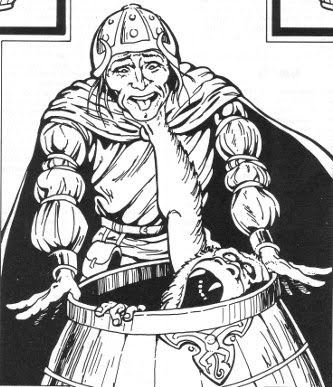
The Barrel of Monkeys
This item both contains an albino ape as well as polymorphs anyone looking into the barrel into an albino ape. Also, albino apes will continue to pop out of the barrel every turn until there’s a hundred of the things. It’s not clear here whether they disappear back into the barrel (or into thin air) once everything and everything nearby has been torn asunder. Or maybe they go on to live fruitful lives of mindless destruction forever after. The barrel loses its power if moved, but not if you move it telepathically. Since it’s not clear where the apes go, and also not clear if when a second person looks into the barrel whether another hundred white apes appears, this thing might very well be a weapon of mass destruction.

Wheel of Burning
Dude should have been wearing his Britches of Coolness

There’s this wagon wheel which, when commanded, throws Light ahead of the wagon on which its mounted. But unlike the harmless Wheel of Lighting, the Wheel of Burning will turn on you if anyone enters the light itself that’s been projected - then you'll feel its wrath! The light it projects will shift to become centered on the vehicle and then start to burn any creatures there. Hence the picture above.

So what's your favorite mundane magic item that you wrote up or that your DM threw at you?

Friday, May 6, 2011

Conch of the Ancients

One of the often touring relics of the order of the Servants of the Servers is a small conch shell made of unnatural materials and adorned with strange markings. A member once placed it into his ear and found that it greatly amplifies sounds. Stroking the side of the shell allows the volume of incoming sound to be adjusted up or down.

The item is said to have once been worn by the great prophet RMS himself, and that he fashioned it with the aid of the Servers. It’s seldom worn now, although occasionally the Chairman of The Beards (the sect’s ruling council) will make secret use of it in order to root out subterfuge.

It’s also lent to high level members who are questing on behalf of the council. At such times, a great deal of publicity is generated and a demonstration of its powers arranged. With skill, the volume adjustment can be made in such a way that when the hands are cupped around the ear and directed, sounds as quiet as a whisper can be heard very clearly though hundreds of feet away.

Many donations are typically generated in this manner, although the entire spectacle takes some preparation and skill to organize in order to minimize mishaps - one questing cleric was permanently deafened in one ear when a baby began wailing at a critical moment.

There are, of course, many more of these items that were used by the ancients - as The Beards well know. It’s been politically expedient to portray this item as unique though, and likely that the initials of RMS were scratched into it in more recent times.
~
This “magic” item of the ancients appears to need no power source. It will allow the user, with practice, to listen to sounds as far away as 300’ with some precision. Care should be taken if used in such a way - it will not work in an environment with a great deal of ambient noise, and sudden and very loud sounds that occur can harm the user or permanently damage his hearing. If continuously worn, the volume can be adjusted so that any surprise rolls against the wearer (or her immediate company) will need to be re-rolled a second time to succeed.
Dedicated to my friend Paul, who just received a cochlear implant.

Sunday, March 27, 2011

The Masks of Gageac

The Masks of Gageac

The magical effects of the Masks of Gageac are quite simple: any two people who wear the masks switch minds with one another for as long as they're worn. Knowledge and skills are retained, although physical attributes (other than hit points) are those of the original host body.

The story of the Masks creation is generally told as follows…

A play was to be performed for the enjoyment of a king on his fiftieth birthday, celebrating his life’s achievements. It was filled with many lengthy monologues, and a few days before the performance was to take place, the lead actor and his understudy had a fight, resulting in the understudy’s death. Though healing priests were brought, the lead actor had suffered permanent injury to his throat. Knowing he could no longer speak his lines, his director scrambled to find a solution to their predicament; they knew that their king was very eager to see the play, and was most fickle and dangerous.

The two were able to enlist the aid of a good magician named Gageac, who had travelled far to see the performance and pay his respect to the king on his birthday. Gageac created the masks, and a willing substitute for the lead was found. When the time came for the play to be performed, the lead and his substitute put on the masks, with the body of the lead now inhabited by the volunteer and waiting just backstage.

The bereaved lover of the understudy struck just as the curtain fell - in revenge, she slit the throat of the one she thought had killed her fiancĂ©. Knowing the punishment she would receive, she quickly took her own life, never realizing that her true target was alive and well but forever trapped in another man’s body.

Ironically, the story of the masks is now itself a popular play and performed in Sarlat, not far from the birthplace of Gageac (which was renamed for him). It’s said that the real Masks of Gageac are also in the Dordogne valley, perhaps hidden in the dungeon below Lord Beynac’s castle, or across the river and possessed by its rival nobles in Castelnaud.

~
Some danger comes with donning the masks: there is a 10% cumulative chance that the mind transfer is irreversible even after they're taken off. This chance doubles if either participant is unwilling and a mask forced on them, and causes an additional 10% chance of insanity in both.

Mask art above is licensed under a Creative Commons Attribution-ShareAlike 3.0 Unported License and a derivative of a previous work found here.

Tuesday, March 8, 2011

The Undead Parrots of Omo Toao

Among the tribal peoples of Omo Toao in the Sea of Os’r, the rare zombie can be found carrying out chores as a way to repay a debt that could never be repaid in life. The arrangement has a number of strict rules involved, including the authorization of the village chief and several witnesses being present at the time the contract is agreed upon. In addition, a witch doctor who initially revives a body and binds its service to another must terminate the arrangement and zombie after an agreed upon time - usually not more than a year.

More commonly found there are the undead parrot heads, or “makemanu”. These are highly prized as novelty items but also have some practical use. Through a process carefully guarded from outsiders, an Omo Toao witch doctor takes a parrot trained to repeat sentences, kills it, and revives only its head - somehow managing to preserve the bird’s ability to speak and repeat short phrases. Each makemanu’s ability varies, but generally only the best birds are used for this purpose. Repeating a phrase to it several times while holding it close to one’s face (a rather unpleasant experience) imprints the sounds. Thereafter, the head will hoarsely squawk the phrase every few minutes. For this reason the heads are usually kept stored away in small baskets tightly wrapped in cloth, especially before being transported.

Makemanu are most often used during yearly celebrations where they’re pitched on poles. Typically in these settings, they’re used to playfully shout insults at passersby or sometimes in tandem with another; one telling a joke and another its punch line, over and over. During the celebration of the vernal equinox, they’re used as a way to convey amorous sentiment. A short love letter or verse is spoken to the makemanu before being hidden somewhere for the target of affection to find at a later time.

They are fragile items, and tend to lose their feathers and fall apart after a couple of years. It is traditional to dispose of a makemanu by fire as destruction by any other method is considered very bad luck. The blue feathered makemanu are most rare and possession by anyone other than King Gramatira or the royal family is a crime punishable by death. He carries a scepter with a makemanu mounted at its apex, and any time the king clears his throat, it announces “That paragon of potentates is going to speak!” Anyone who interrupts this announcement is also punishable by death.

Monday, December 13, 2010

The Skunk Ape and Rudian Fruit

The Skunk Ape

A strange ape of reclusive and solitary nature dwells in the southeastern jungles of Zirthus. The creature gets its name from the horrible stench it exudes due to its diet, which consists entirely of fruit from the rudian tree. Usually avoiding any conflict, it can become very aggressive if it feels its food source is threatened.

Armor Class: 6 [13]
Hit Dice: 3
Attacks: 2 hands (1d3), 1 bite (1d4)
Saving Throw: 13
Move: 12
CL/XP: 4/140
Special: 30’ radius odor causes -3 on opponents’ “to hit” rolls. Can hide in dense foliage and surprise on a 1-3.


Rudian

The fruit of the rudian tree is well known to the primitive human tribes that share its tropical habitat. While the leaves of the tree can be rubbed on the skin as an insect repellent, the fruit itself is usually left alone. It's edible and said to have a foul flavor, but be strangely addictive. Those that consume it exude a very offensive odor, so powerful that it can cause dizziness and headaches in those nearby (though its undetectable to the consumer).

In times of war, a tribe’s best warriors will consume rudians just before battle. This is the only time its acceptable to eat the fruit in their society. Their legends speak of men who became addicted to it - over time these men turned into hideous apes, their war paint permanently etched into their skins and their stench causing men to weep and run for their lives.

The stinky rudian can only be successfully eaten by a PC if they make a d20 roll under their Constitution score. If successful, after 3 turns their armor class will improve by 2 points in a 30’ radius. This effect will last for 8 hours. Characters who have not also eaten the fruit will refuse to stay within 30’ of them, although another Constitution check is allowed.

If a rudian is consumed more than twice in a month, a saving throw must be made or else the PC will become addicted. If this is not cured within a month and even if no more rudians are eaten, the character will transform into a skunk ape (save allowed).

A rudian tree is rare - only one will be found in any 5 mile area. At any given time, a tree will have 3d6 fruit hanging from it.
--
I’ve been wanting to write up a skunk ape for awhile, Aaron’s post reminded me...
Text of this post is licensed under the OGL.

Tuesday, September 21, 2010

The Skull Mace of Weinberg

Appearing at first to be an ornamental weapon, the Mace of Weinberg’s handle is made of silver with a painted crystal skull about six inches in diameter as its head. The name “Friedrich” is inscribed in runes along its length. Once per day, when the mace is held and this name spoken aloud, the skull will glow and illuminate a 30’ radius with a pale blue light for a duration of three hours. Corporeal undead within range of this light must make a saving throw or else be Slowed for three turns, moving and attacking at half speed. Ghosts and other non-corporeal undead will not be slowed by this light, but still must make a saving throw - if they fail, they become vulnerable to attack by normal weapons for three turns. The mace can be used to hit them in either state, although against living creatures or the corporeal undead it should be treated as a normal mace -1. The item may break if used in this manner, but the crystal itself appears indestructible.

The crystal skull is a kind of magic jar for the ghost of Friedrich and the mace exudes an aura of evil to anyone or thing that can detect it. Friedrich can and will only emerge from the skull to attack if the mace is broken (in a critical fumble or otherwise). If this happens, the crystal will cease to glow and lose its power.

Long ago, a necromancer bound Friedrich to the weapon. It’s magic power derives from this and is very different in the hands of someone like its creator. Every time the magic power of the mace is invoked, Friedrich experiences pain beyond imagining - a fact he will be eager to share with a party and seek revenge for should the opportunity ever arise. Though the mace can be repaired if broken, if Friedrich is not somehow re-bound to the crystal its only value is monetary.

Friedrich the Ghost: AC 0 [19], HD 8, HP 35, Attacks: Touch (d8 cold damage), Saving Throw: 8, Special: Touch attacks also cause aging of 10-40 years (Save allowed); immune to spell attacks cast from the material plane; can only be hit by silver or magic weapons. Friedrich is completely insane and will attack a human male before others in the belief that he’s responsible for originally binding him.

Accompanying image licensed under the Creative Commons Attribution Share Alike 3.0 Unported license. Based a prior work by Steaphan Greene and public domain image brought to my attention by Telecanter.

Sunday, August 29, 2010

The Acme Settler Servant

The economy version and long discontinued counterpart to the better known M.U.L.E., Acme’s Settler Servant (or the A.S.S. for short) was a more primitive robot with a smaller power cell and carrying capacity. It was a favorite among early terra-formers and planet pioneers for its cost-effectiveness, hardiness, and near total lack of maintenance requirements.

There are five movement modes which can be manually set by a simple dial on the side of the robot. All models originally came equipped with remote control and programming devices but unlike the A.S.S.es themselves these were fragile - discovering them in a functioning condition on abandoned settlement planets is even less likely than encountering a still functional A.S.S. The manual movement modes are:

Down: The unit will lower itself until its main body is six inches above the ground.
Stay: The unit’s legs lock and it can only be moved by being picked up or pushed over.
Neutral: The unit will move if pushed or pulled, up to its maximum speed.
Walk: The unit will move in a straight line at walking speed.
Run: The unit will move in a straight line at running speed.

There is also an easily accessed and simple flip panel with a palm sized red button marked “STOP!” at the rear of the robot. This functions as a kill switch (it reverts to neutral mode when depressed.)

The lack of quick turning ability in the unit’s design was intentional and intended as an incentive to upgrade. Because of the unreliable (or often missing) remote controls, the robot was generally harnessed at the front, and by pulling strongly to the left or the right its forward direction could be changed. Similarly, the robot’s orientation and stabilization software was crippled - loads needed to be placed no higher than a foot or so above the main body or the A.S.S. could not move properly. A number of hooks were regularly spaced along the length of it where storage containers or tools were intended to be attached for carrying.

The small but highly efficient B-1 power cell found in the A.S.S.’s abdomen was intended to be quickly recharged or swapped out at spaceports and even with heavy use a charge might last years. The A.S.S. lacks a true power switch, and when not in motion it quickly enters an energy efficient sleep mode. A much valued innovation at the time was its implementation of nano-solar cell technology embedded throughout its metal skin. Incredible as it may seem, battered but still functioning A.S.S.es have been discovered on planets that were abandoned centuries ago by their original settlers, provoking more than one historian of robotics to say of the A.S.S. “They just don’t make them like they used to!”

It should be noted that this is also a good thing: More than once settlers were accidentally dragged for miles and to their deaths, spurring some of the early and strict regulations now in place for mechanical beasts of burden. In later models the manual control dial must be pushed in and turned simultaneously to change a setting in order to lessen the chance of accidentally triggering a mode change. The A.S.S. fell in popularity when other manufacturers developed more sophisticated models with proper voice recognition and more reliable remote controls.
..
Acme Settler Servant (Robot): AC 4[16], HP (up to 100), movement and carrying/pulling ability as warhorses x 2 (see additional carrying restrictions above)
..
Students of robotics history may find of interest the archival footage (below) of what’s thought to be an early prototype of the A.S.S.

Monday, July 19, 2010

The Ocarina Skull


I thought I’d join bat and David in writing up another magic skull.
..

Ocarina Skull

A relatively common magic skull, most of the openings of an Ocarina Skull are sealed with wax or mud. Several new holes have been carefully drilled into it, allowing the skull to be blown into and played as a musical instrument.

Unless the exact melody intended to be played with a skull ocarina is known, the magical power or effect caused by using one can be dangerous and unpredictable. Roll on the table below, use d4 if the tune is known, d10 if not (saving throw allowed.)

1. Animate and control d4 skeletons in vicinity.
2. Turn/Bind Undead - At level of user, based on alignment - clerics get bonus turning/binding attempt.
3. Curses enemy listeners within a 30 ‘ radius (-1 on attack rolls for 1 hour.)
4. Causes Fear in enemies in a 30’ radius - flee for one hour.
5. Causes user to cease playing the Skull Ocarina and laugh maniacally and uncontrollably for d6 turns.
6. Causes deafness for one day for all listeners (including user) within 30’ radius.
7. Summons up to d12 hostile undead from within a radius of 30’ times level of user.
8. User and listeners in 30' radius are compelled to shave their heads. If their heads are already shaved, they will furiously attempt to do so again, causing a hit point of damage in their zealousness. Those without bladed weapons will beg others to help them or loan them theirs.

9. Irresistible Dance - User, friends, and foes alike within 30’ are compelled to dance for 2-5 rounds, reducing armor class by 3 and making other actions impossible.
10. Causes everyone within 30’ radius (including user) to stop what they’re doing and attempt to dig a grave for one hour. If the terrain allows for it and there are enough present to succeed within the duration, a random participant will volunteer to lay down in it, whereupon the others will fill the hole back up again. Any time left in the hour will be spent idly standing over the grave or in murmuring prayers to whatever deities are worshipped. Anyone attempting to stop this activity or uncover the grave will be attacked by those effected.
(all effects occur once per day)


I can see using this with either a visual puzzle of some kind where a pattern needs to be played, or else with a riddle along the lines of “name that tune” where I either give lyrics as clues or somehow justify playing a short clip of music (a Magic Mouth might be useful here.)

Sunday, July 4, 2010

Six Flags. Magic Ones.

Very powerful symbols make for very powerful magic items. Here's six...

Flag of Doom

Those who behold the flag of doom within a distance of sixty feet are immediately filled with fear and must make a saving throw or else hightail it for d6 turns. Those who make their saving throw still suffer a -4 to any morale rolls made during the encounter.

Flag of Allegiance

Those who behold this flag within sixty feet must make a saving throw or else are charmed by the flag bearer and will surround and follow him, protecting him and the flag with their lives if necessary. The spell is only broken if the flag should touch the ground or if the bearer can be interpreted in any way as disrespecting it.

Flag of Duplicity

A cursed piece of cloth, this item first appears to be the flag most favored by those who unfurl it. Viewed from a distance greater than 100’ though, its colors change to become the most dangerous flag for its bearers or the one who hoisted it depending on the situation. For example, it might become totally white, signifying surrender, or it might become the flag of the enemy on a battlefield, or it might suddenly become the Jolly Roger on the high seas when a friendly navy vessel comes into sight, etc.

Flag of Mirth

Unfurled and hoisted, anyone within 100’ who beholds this flag will be overcome with goodwill for everyone else in sight (save allowed) with the effect lasting a full day. Indeed, a celebratory atmosphere will quickly descend on the area, with spontaneous singing, dancing, and general all around back slapping. Needless to say, any alcohol or food in the area will be shared and consumed in earnest by those affected - although no one will want to leave the area of effect in search of more.

The Yellow Flag of Holding

A small yellow flag - if taken from storage and thrown to the ground, all those in a 30’ diameter area must make a saving throw or else be immobilized (treat as Hold Person spell.) It can only be used once per day.

Flag of Bafflement

Once per day, this flag can be used to cause up to twenty creatures who see it at ranges of less than 120’ to become confused for two hours. On a roll of 2d6, the creatures will do the following:

2-4 Attack Bearer & His Allies
5-9 Stand baffled and debate the flag’s design/meaning.
10-12 Attack each other.


The dice are re-rolled every ten minutes for the duration of the two hours.
--
If you live in the U.S., Happy Independence Day!

Sunday, April 4, 2010

Magic Hats, Here's a Dozen

There seems to be a dearth of magic hats in Dungeons and Dragons.* Sure there’s a smattering of magic helms, but considering the iconic hat wearing wizard, the absence of hats or caps in the magic item sections is odd.

Perhaps it’s because of the modern “fake” magician, and the cliched pulling a rabbit out of his hat that makes us shirk from utilizing magic hats in D&D. Maybe it feels silly, or cartoony somehow, and we shy from it for that reason. The comical attempts of Presto (in the Dungeons and Dragons cartoon series) to save the party with his hat may have helped to indelibly corrupt the idea of a more noble or useful magic hat in our game. Or maybe it’s a darker thing - maybe at an early age we learned from Mickey Mouse (in Fantasia) the terrible things that might happen when you put on a magic hat.

On the other hand, it may be that the utility of a wizard’s hat is just implicitly understood. That’s where the spell book is kept, or spell components… Of course that’s where small conjured items initially appear. Personally I’ve never really given it much thought. I think I assumed that magic users use their hats mostly as a way of identifying one another (although painting a target on one’s head in such a manner seems a bit unwise). Maybe the color or style of a hat functions as a type of guild status or designation of a degree of mastery. Maybe it’s just foppery. Which isn’t to say that all of my games’ magic users have even sported the things. But again, I really haven’t given it much thought until recently.

A host of spells are easily adaptable and well suited to being contained in magic hats. Here are some that immediately come to mind, as well as a few more unusual ones (including one very unpleasant, cursed hat). They’re minor magic items since I was thinking of my own campaign and the low level PCs there...

Gusty Hat

When held outright with both hands and pointed bottom facing out, performs once per day as the 3rd level magic user spell Gust of Wind. Of course, this hat can't be blown off its wearer.

Egis Nuns’ Hat of Grog

Per the 3rd level cleric spell Create Food and Water, but only produces beer.

Hat of Dapperness

A rather common magic hat, it conveys +1 charisma to wearer and allows one re-roll on the reaction table per day.

Hat of Feather Fall

When held with both hands above ones head, functions like the first level magic user spell. Decorated with a normal feather, it will function as a normal hat if this is removed.

Hat of Teleporting Objects

Any object that can fit inside the hat (say, a little less than a foot in diameter) can be teleported by being placed there. Up to 100gp of weight can be transported this way once per day. Other than this limitation, it functions like the 5th level magic user spell.

Hat of Inconspicuousness

Once per day, the wearer of this hat will be seen but not recognized (unless he wishes himself to be) whenever in the presence of more than four people in a 30’ radius.

Ventriloquist’s Hat

Usable only by magic users, it immediately bestows the ability (upon the last magic user to touch it) to cast the 1st level magic user spell Ventriloquism with the following differences: the projected voice will only emanate from the hat, the distance it can be used is increased to 30’ per level, and there is no duration limit.

Peterman’s Hats of Desiccation

The wearer of this hat and his possessions will remain completely dry as long as the hat itself is never completely submerged. Anyone who is wet will become instantly dry upon wearing it. It also instantly and completely evaporates any liquid possessions of the wearer.

Hat of Holding

A conical hat, it functions like a Bag of Holding, only the diameter of the entrance is only half a foot wide (being near the narrow end of the hat), its weight limit is 50gp, and its volume limit 3 cubic feet.

Hat of Skulking

Bestows the thief class ability of Hide in Shadows at the same level of the wearer. If worn by a thief, attempting to Hide in Shadows will always fail.

Hat of Jesting

Much like the Hat of Dapperness above, this hat conveys the ability to re-roll on the reaction table, in this case an indefinite number of times - but only if the player actually tells a joke. Fortunately, it doesn’t have to be funny.

Buck’s (Cursed) Hats of Misery

A very disgusting and humiliating item, when Buck’s Hat of Misery is worn, the wearer immediately becomes nauseous and will vomit. Into the hat. They will then be compelled to place the hat back on their head. Otherwise, the hat cannot be removed by the wearer and will be firmly stuck on. Unless the victim is cured via a Remove Curse spell, every time (or at least once per day) there is a tension filled moment in the game (such as just before a battle) the wearer of the hat will again vomit into it and then replace it. Aside from the unpleasantness, this will adversely effect the reactions of others and possibly cause the loss of initiative. If others forcibly remove the hat with great effort, the former wearer will become totally incapacitated and violently ill. If the hat is not returned to their head, they will drop dead (save vs. Death allowed every d4 turns). The curse will continue until someone else that knows the first wearer dons it, whereupon the curse will be transferred.

* I should say that I only have 2nd edition and earlier books, and my only 2e Magic Cyclopedia stops at the letter G. Likely I won’t have looked hard enough. Photo by pokpok.

Monday, March 29, 2010

Eight Magic Torches

There are some players who will scoop up just about anything underground that seems useful. I'm usually one of them, but sometimes it's not wise to fool with Mother Dungeon...

Torch of Pointing

Although normal sized, this torch only illuminates 5’ in diameter when held upright. When pointed, it works as a spotlight, allowing the illumination of an area about 3 feet in diameter and 100 feet away. Although detail may not be able to be seen at such a distance, any such light will be brightly reflected from the eyes of any creatures with the ability to see in the dark, also marking them as potential missile weapon targets.

Stinking Torch:

A Stinking Torch functions normally for a turn before suddenly spewing out large smoky clouds of noxious yellow vapors in a 10’ radius. This causes d4 hp of damage to anyone in range (saving throw allowed), but otherwise should be treated as per the 2nd level magic user spell “Stinking Cloud”.

Hungry Torch:

This magically cursed torch consumes the rations of anyone within its area of illumination. It does so at a rate of 5 rations per turn (and will burn for 12 turns). Food directly illuminated by the light from such a torch will change in appearance to become hazy as if exuding heat before disappearing entirely - and be consumed at the rate of 5 rations per round. Anyone touching disappearing food will be burned and unable to hold onto it (or 1 hp/round of damage if it’s attempted), although this heat will not cause anything else to ignite.

Inextinguishable Torch:

This torch is otherwise normal but will burn for 24 hours straight and is completely inextinguishable, burning underwater, under extreme wind, or any other physical circumstance. It can be put out with a Dispel Magic spell (but may be relit and reused for as much time that remains from its initial use) or counteracted with a Darkness spell.

Black Cat Torch

D6 rounds after being lit, this cursed torch will begin brightly sparking, emanating extremely loud bangs and a great deal of smoke (treat as 2nd level Magic User spell “Pyrotechnics”).

Cowardly Torch:

This torch burns a very long time (12 hours) but immediately extinguishes itself if exposed to typical combat noise (such as weapons colliding against each other or armor).

Molasses Torch:

Anything within this torch's area of illumination will suffer movement and attacks at half speed, no saving throw allowed. If the entire party is within range, they won't notice anything out of the ordinary.

Torch of Blunting:

Any edged weaponry exposed to the light provided by this long lasting (six hour) torch will become dulled and -2 to hit/damage for the duration. Close examination of such weaponry (studied cleaning or sharpening) will reveal that no reflection in their metal can be seen in this torch's light. Otherwise it provides normal illumination.

Saturday, October 31, 2009

Worling's Magic Items

For fans of the famous wizardess of the British Isles:

Hand of Pilfering

Any lit candle placed into this dried, shriveled, and clenched humanoid fist will provide illumination as would a normal candle to only the person holding the hand. Anyone else will see the candle go out and no illumination provided. Prized by human thieves and owlish wizards and alchemists.

Mirror of Enemy Detection

This mirror will show its owner’s possible enemies (oppositely aligned creatures) within a 100’ radius. The images will be blurry or sharp depending on how far away the enemy is - in the case of multiple types of enemies, the images will rotate through a gallery of them, pausing a few seconds on each.

Light Snuffer

A candle snuffer that can extinguish sources of light at a distance, it's used as a wand, has a range of 100’, and can effect up to one dozen separate non-magical (ie. torch, lantern) light sources at a time once per day.

Teleportation Powder

Effects per the spell but usable by up to three individuals simultaneously, this powder is thrown onto a large fire which is then stepped into as the powder causes the flames to momentarily shoot up and produce a prodigious amount of green smoke. Often a magic item of last resort, in order for the teleportation to work, a saving throw must be made. Those who fail will not teleport and will take fire damage accordingly.

Friday, July 17, 2009

Runic Orbs

I'm looking hoping for feedback on these relics/magic items I plan on introducing to a future campaign. I'm fairly happy with the details of the items, their history, description, etc. but am still struggling with the dangerous side of them and some of their powers in general.

In addition to the part they'll play in the larger setting, I wanted an item that could be slowly assembled and quested for, and something that could be a part of any end-game.

Runic Orbs

History/Background

In ancient times, before the gods took notice of the Material Plane, it was the playground and feeding place of demons. These demons would torment and abuse the young human race for sport. After many years of demonic attacks, a group of powerful wizards formed what would much later become known as the First Guild. To defend their settlements, they created a Runic Orb of tremendous magical power, composed of separate pieces. Each piece was held in trust by a high-ranking member, but could be magically and magnetically interlocked with the others. In this way the great power of the Orb could be shared and was prevented from being used without democratic consent. Were it to be used too often by one person, the incredible power contained in the sphere would drive even the most well meaning of souls to madness. Legend says that for this reason, the original Great Orb was eventually destroyed, although some say it can never be destroyed - only deconstructed into its parts. In any event, its possible whereabouts and specific powers are unknown now. Similar (but less powerful) Runic Orbs are said to exist, rumored to be buried in forgotten tombs or disassembled and strewn throughout ancient ruins. The knowledge of their construction seems lost forever.

Powers, Use, and Vulnerability

There are two kinds of Runic Orbs: Greater and Lesser. A Greater Orb comprises twenty- four interlocking pieces, each piece inscribed with a single rune (or other type of magical glyph). They are approximately twelve inches in diameter, and weigh about twice that number in pounds. Lesser Orbs are similarly constituted, being but six inches in diameter when whole, weighing about twelve pounds, and of only twelve interlocking pieces. The pieces that make up an orb are made from a metal that appears to be cast iron, but that is resistant to rust and virtually indestructible. Both types of orbs and individual pieces are black as coal. When fully constructed and touched by human hands, they become illuminated from within (treat as Continual Light spell).

The powers of Runic Orbs are varied, but are magically linked to the lunar cycle. During the waning cycle, the power of the orb is limited to diminishment. Dispelling, destruction, darkness, silence, invisibility, removal, confusion, restriction of movement, fear and bewilderment - these are the domain of a Runic Orb’s powers during this time. Conversely, during the waxing cycle, creation, light, protection, curing, finding, enhancing movement, and growth are examples of the power of the orb.

Only the magic user class can utilize the power of Runic Orbs: Lesser Orbs confer up to twelve levels of spells per day, Greater Orbs up to twenty four levels. Although these spells are unchangeable, they vary from from one orb to another, and also vary based on the lunar cycle. For example, during the waxing moon a Lesser Runic Orb might contain the 2nd level spell Locate Object, the 4th level Plant Growth, and the 6th level Reincarnation. During the waning cycle the same Lesser Orb might contain the spells Hold Portal, Confusion, and Mass Invisibility, or even just twelve instances of Sleep.

When holding an orb, the magic user is suddenly aware of the item's spell-conferring abilities, and as occurs with his own spells, forgets them once they are cast. These orb- derived spells are then unavailable until a full day later. Unlike magic scrolls, an orb cannot be used as a way to learn new spells. A Lesser Orb can be held in one hand while the other wields a weapon or is involved in spell casting. A Greater Orb must be held with both hands to be used.

Although the pieces of Orbs are indestructible (even by the use of a Wish spell ), an Orb itself has a hit point value of d4 x12 (Lesser) or d4 x24 (Greater) and an Armor Class of 0. If the hit point value of an Orb reaches zero, the magnetic power of its parts fails, and it will fall apart, effectively removing its power. The magnetic attraction of the parts to one another will not return again until a full day has passed. This attraction only adheres the pieces to one another once they've been placed into physical contact - it does not work over any distance.

Runic Orbs and pieces of them are only solid for and can only be handled by natives of the Prime Material Plane and cannot be transported by any means to other planes.

The Curse of the Orbs

The power of the orbs is mighty indeed – but its creators wisely ensured that its use carry a price. If an orb is used on more than one day in a month's time, a saving throw must be made per additional day of use. Failure to save results in a permanent loss of wisdom points. See the table below (Greater Orbs penalties in parentheses).

Note: Non-magic user classes/races are not affected by this as they can't use these items. Optional exception: even attempts by halflings (curse them!) to use these items will be penalized as per magic users.

Wisdom lost in this way may not be restored by any magical means. Reduction in Wisdom to less than 3 effectively removes the player character from play, as at this point the PC will be a raving lunatic.

Rumors/Legends

Parts of Runic Orbs may be interchanged with the parts of other Runic Orbs, but there is no clear, predictable outcome - the abilities of the orbs may stay the same but may change dramatically and at random. It's also unclear if a specific arrangement of the pieces of a particular orb will to empower it with specific abilities. It’s said, though, that certain ancient scrolls and magical tomes record theories and purported explanations of the science and power of the orbs. If such knowledge was recorded, it's most likely lost to antiquity, or very heavily guarded indeed.

Very high-level magic users and the Elven Kings know that there are twelve Lesser Orbs for each of the Greater Orbs and some believe that the mystery of the original Great Orb is contained in these others. Since the supposed destruction of the Great Orb, demonic attacks have increased in numbers and regularity. There are those who consider the reunification of The Great Orb to be possible and actively seek for its pieces. Some note with interest that the Gods only revealed themselves to Man after the creation of the Great Orb. Perhaps some of them feel threatened by the very existence of such a relic and compel their followers to quest for pieces of it, although given the Earth-bound nature of the pieces, what purpose they might have is unclear.

The Great Orb

I wasn't aware of runic orbs elsewhere until I began hunting a little for art components and discovered that they're apparently found in WoW (I've still never played it). I suspect these items bare little or no resemblance to the items in that game though.

Re: artwork above, I have a new respect for the artist behind the wikipedia icon, which I obviously (!) borrowed, removed symbols from, texturized and darkened, and inscribed with the elder futhark by hand. Attempting to create a decent similar item with the proper number of (12 or 24) pieces was a frustrating exercise, but the image of the Lesser Runic Orb (above, top) is an example.

Thursday, June 25, 2009

Potion of Forgetting (Magic Item)

I’ve been fixated on The Mirror of Fixation a bit and somehow that lead to thinking about magic that can cause one to forget. In a sense, the Mirror of Fixation does this, forcing you to forget everything except love of self. But there is similar magic which isn't so focused in its effect. Unlisted in Dungeons & Dragons rules until the advent of AD&D is the 2nd level magic user spell “Forget”. While it’s ironic that a magic user will forget the Forget spell after casting it per the usual D&D magic rules, it’s also ironic that it seems to be forgotten from the D20 SRD.

Fine, adapting the Forget spell from OSRIC or the 1E Player's Handbook for use with Labyrinth Lord is not a problem, but I can't find explicit references to Potions with the same effect in the old D&D rules sets (including 1E). It seems unfair to let the Harry Potter fans hoard their Potions of Forgetfulness. So like the Mirror of Fixation, not finding this previously described in our game's ancient tomes I felt obliged to "create" and document this simple item here...
--
Potion of Forgetting

This tasteless and colorless liquid substance will wipe all memory of recent events from the person who imbibes it. The potion's effects are permanent and will generally remove all trace of the last hour's worth of memory (save allowed vs. Spells/Spell-Like Devices), although sometimes less: experienced alchemists know that Potions of Forgetting are notorious for losing their efficacy over time. Legends tell of more powerful Potions of Forgetting which have been known to wash away memories weeks or even years old, but these are extremely rare.

Every imaginable sort of trickery and deceipt have been accomplished through the use of this item. Because of the difficulty in detecting its presence, it's often used to spike food or drink. Potent stuff, it can even be thrown into the face and eyes of an individual (saving throw made at +2). Known to be used in traps as a liquid projectile, spies and thieves are still very fond of and familiar with this potion. When else can you throw what appears to be your drink directly into the face of a bartender, resulting only in the convenient erasure of your tab?

Strangely, some folk have been known to willingly imbibe or wash their own eyes with this potion after witnessing something incredibly horrible (thanks Al!) ... As there may be a slightly addictive quality to the potion when taken repeatedly in such a manner, dungeoneers are encouraged to stick to the equally addictive but cheaper and probably safer liquids of scotch, ale, and mead when dealing with heart or sword break.

Friday, June 19, 2009

Mirror of Transfixion (Magic Item)

Arguably the most common type of magical mirror is that which traps those who behold their own image within it. There is of course the Mirror Of Life Trapping, referred to in the 1st edition of the Dungeon Master's Guide, but that's a bit more elaborate than the classic, simple, immobilizing mirror which I'm envisioning. Also within that sage tome, you'll find the Mirror of Mental Prowess and the Mirror of Opposition. So mirrors being all the rage this week (see bat's Mindseye Mirror and Lord Kilgore's Mirror of Yesterday spells), and not finding written elsewhere what I've been looking for, I thought I'd document my own modest creation here...

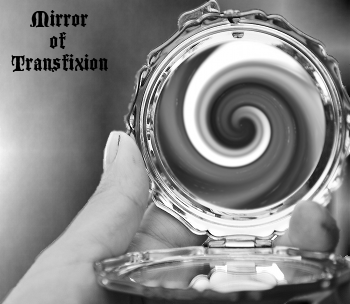
Mirror of Transfixion

Also known as "Mirrors of Invanity", anyone who sees their own reflection in them must make a saving throw against Paralysation. Charisma Reaction Adjustment scores are tripled and then added to (or subtracted from) the roll. For example, a 2nd level fighter with Charisma 18 should subtract 6 from their d20 roll, effectively requiring him to roll a "20" to save. Similarly but conversely, a homely 1st level dwarf with Charisma 8 adds 3 to his saving throw roll, effectively requiring only a "7" to save.

Failure to save will cause the victim to stare at their reflection in the mirror in total self-love and admiration for a full day. Attempting to break their gaze or to take the mirror from them will result in a furious attack until they are unconscious or until the mirror is returned, whereupon gazing will begin again. Breaking a mirror which has currently bewitched anyone will cause damage equal to one third the Charisma score of the victims, rounded down, +2HP per character level. Victims can be moved by being pushed and pulled about, as long as they're permitted to continue primping themselves and staring into the mirror.

Mirrors of Transfixion can come in any size, although the smallest are most desired as sources of entrapment and mischief. These pocket sized items are usually made of silver, their delicate and ornately decorated outsides being hinged, hiding and protecting the mirror surface itself until opened.

Update: I struggled a bit with determining how to calculate damage if a bewitching mirror is broken, although I'm sure I want it to be at least partially dependent on the charisma of the character - suggestions welcomed!

Image source: CC licensed photo by flikr user caryatidxx, GIMP'd by le bulette and also CC
Attribution-Share Alike 2.0 Generic licensed :-)

Sunday, June 14, 2009

Gauntlets of Grasping (Magic Item)

Appearing to be normal if somewhat decorative, Gauntlets of Grasping are never meant to be worn simultaneously. When only one is worn, the other's movements will mimic that of the one which is... This is usually quickly ascertained by any first time wearer - as soon as one puts on the glove and flexes their fingers/hand, the other glove will move accordingly. The effect is maintained at a distance of up to 60' from the other glove. A wearer can even move the unworn glove across the ground in a crude crawling fashion by moving his fingers appropriately.

The gloves have a small degree of sentience - they are neither Good nor Evil in nature, but are in some sense "married" to one another. If they are further away from each other than 60' and one is worn, the worn glove will become scalding hot, forcing the wearer to remove it or suffer 1hp of damage per round. If both gloves are worn simultaneously, there is a 50% chance that the gloves will attack the wearer by attempting to strangle him (treat as HD 1, AC 6, Atk 1 (1d4) Save 16). Anyone attempting to help the wearer in such an event is just as likely to be attacked themselves.

Prized by mischievous creatures as well as by men for the pranks these gauntlets make possible, they've also been known to be used in elaborate traps. A story is told of a dramatic prison escape involving this item.

I came up with this idea on a road trip with Vince a while back. Other name suggestions welcomed! Artwork is an adaptation of CC licensed photo by flikr user unforth, I used Gimp and Delineate. Artwork available under a Creative Commons Attribution Share Alike 2.0 Generic license.

Tuesday, June 2, 2009

The Truth Telling Pig (Magic "Item")

The Truth Telling Pig, or "Le Porc de la Vérité" is a rare magic item found only in very rural farming communities.

It is rumored that the first such "Pig of Truth" was created by a wizard in sore need of rest and recuperation, following an epic battle. Penniless, the wizard is said to have magicked a farmer's pig in trade for being allowed to stay and convalesce in the care of the farmer's wife. Ironically, some say that it was the pig that led to the wizard's demise, as the farmer was ultimately able to prove the wizard's adulterous behavior to the local village elders and militia. These pigs are highly sought after as breeding of them has proven they're able to pass their magical ability on to their litter, although this seems to be rare and possibly attributable to how well the pigs are cared for prior to their becoming pregnant.

How it works: Anyone who lays a hand on the pig and speaks can be determined to be telling the truth or to be lying based on the appearance of the pig's spots: If the person is lying, the spots on the pig will begin to coalesce and arrange themselves in such a pattern that the unmistakeable word "Liar" will be seen upon it. Similarly, truth tellers will reveal the word "True" in the spots on the pig. No saving throw is allowed for the person(s) in contact with the pig.

If more than one person touches the pig simultaneously, or if one person holds hands or otherwise touches another person who touches the pig, results will be similar (ie. "True" or "Liars" will manifest), but if one or more people tell the truth but one lies, or vice versa, no spots on the pig will rearrange, and the result will be inconclusive.

Those seeking to somehow assume the truth-telling abilities of the pigs through consumption of them take a great risk in doing so:

Roll 1d6:

1: No Effect
2. Consumer can only tell lies forever after.
3. Consumer must answer any direct questions and always truthfully.
4. Consumer alternately tells the truth and then lies, every other sentence.
5. Consumer can speak the truth, but always loudly snorts afterward.
6. Consumer gains the ability to Detect Lie (as per the spell) once per day.


(Published in Knockspell #3)

This magic item was completely inspired by Jim Woodring's "Truth Telling Pig" illustration, pictured above.