Posts


At the risk of going over some well trod territory, I thought I’d share some notes I’d jotted down as something worthy of investigation - The section entitled Avoiding Monsters in the Underworld and Wilderness Adventures book (volume 3 of the original D&D booklets). The rules laid out there are very specific - some of them I’ve used and some of them I haven’t (probably since I originally started playing with Moldvay’s rules). Now that I play S&W: Whitebox, it’s interesting to more closely examine the beige books’ idiosyncracies.
One item of note is that monsters in OD&D will automatically attack and/or pursue unless their adversaries are obviously stronger and the monsters would know better. This is versus Moldvay, where some monsters always act in the same way and attack, but the reactions of most vary: “The DM can always choose the monster’s reaction to fit the dungeon, but if he decides not to do this, a DM may use the reaction table…”
So basically, Moldvay says “Use your best judgement” whereas OD&D says “Monsters are monsters - their raison d’être is to attack you. If it was otherwise, they’d be potentially dangerous animals or perhaps intelligent beast-men. We’re not on a zoological expedition kids, we’re monster hunting.
Also, Moldvay has a Reaction Table but OD&D has a Random Actions by Monsters table. In Moldvay, the monster might even become your friend! In OD&D, the monster might respond positively to something, but we can still assume that it wants to kill us. This seems contradicted by the inclusion of neutral and lawfully aligned creatures listed in Monsters and Treasure (volume 2). Maybe those should just have been listed separately as “Other, Non-human Beings."
One might conclude at least a couple of things from this reading: First, that OD&D as written is decidedly more hack and slash. Second, that there isn’t as much moral ambiguity in OD&D as there is in later editions. Maybe it was the fact that the game was becoming popular with kids and criticisms were being raised at the time that led to these particular rules being revised. Nobody wants to be accused of teaching children that there are intelligent beings not worthy of moral consideration precisely because they don’t consider you worthy of moral consideration (they just want to kill you). But…that’s just what monsters are - that’s what they do.
Maybe all subsequent hand wringing about goblin baby killing could have been very easily avoided if the term "monster" had simply been better defined. Or maybe it’s not that easy... just easier to let the dice be the judge.
Tuesday, November 29, 2011
Sunday, November 27, 2011
The Illustrious Josh Kirby
Some scanned artwork by the late Josh Kirby - I love the old school feel of these black and white illustrations from the '86 T&T paperback.


Labels:
Art

Wednesday, November 23, 2011
Season of the Witch - Paper Mini
 The small town of Belves is host to a coven of witches which meets there at least four times a year. There are currently eleven members, led by the redheaded enchantress Lucienne.
The coven is divided into four groups of three members, each group corresponding to one of the four seasons. Each of these has a member aligned with one of the forces of law, chaos, or neutrality - though the members frequently argue and scheme against one another, they also see the wisdom of periodically coming together to pool their individual magical powers and support the current season’s three members.
Every year they elect a leader whom they then gift potions and various abilities. In this way, though they’re considered an equal, their leader is also more powerful and better able to resolve any serious disagreements.
Several years ago though, a dispute within the coven led to a leader being exiled. Known as Hecatha, she was eventually overtaken and cast out by the others when she refused to relinquish the power with which they'd entrusted her… To this day, the Great Druid still searches for a cure to her self-inflicted curse, which manifests in both physical deformity and madness.
With the witches’ number and power now diminished by the loss of a member, Lucienne seeks someone to fill Hecatha’s shoes. She fears what might happen if Hecatha was somehow able to regain her mind and former power… and Hecatha’s season approaches.
click the thumbnail image above for a closer look or to download the 4x6" (index card formatted) paper mini PDF
see also: Hecatha and Witch and Watchers minis
Labels:
Dordogne,
Paper Minis
Tuesday, November 22, 2011

Saturday, November 19, 2011
Deep Space Nine and Thieves
I’ve been watching a lot of Deep Space Nine on Netflix over the last month. Back when it premiered, sitting through the CGI intro wasn’t so bad - after all, it was only on screen for a few minutes once a week. Now though, when watching an episode every other day or back to back, having to wait for the music and opening credits to finish is painful. Or rather, it’s painfully obvious that the whole sequence is ridiculously overdramatic. The wormhole’s depiction begins to seem less like a triumph of computer special effects and more like a giant bowel movement, opening up as it does to drop a spaceship deuce from time to time. Consider that the Bajorans' prophets live inside the wormhole - apparently talking out of their ass.
Aside from that initial unpleasantness, it’s sometimes fun to take a short nostalgic trip back and watch this show. DS9 is less of a hex-crawl, if you will, than the other Star Trek series. Supposedly it was more critically acclaimed than those other series too - I wonder how much this has to do with the ability to create more complex and interwoven plots due to the stationary setting. I keep making mental notes to use this or that element in a Traveller game I'll never actually play. One of my favorite episodes is when a priestess from a fundamentalist branch of the Bajorans’ religion has a fit because they’re teaching kids on the space station that the wormhole is host to aliens (rather than “prophets”). Then someone blows up the school with hilarious consequences.
Somewhere along the way, I realized that the Ferengi “Rules of Acquisition” could be converted fairly easily into a Thieves Guild’s (or a god of thieves’) Rules of Wisdom. Just change “latinum” to gold and “sale” to “theft” and you're halfway there...
Corrno’s Lesser Rules of Wisdom
1. Never allow family to stand in the way of theft.
2. A man is only worth the sum of his possessions.
3. Keep your ears open.
4. Greed is eternal.
5. Anything worth doing is worth doing for money.
6. A deal is a deal - until a better one comes along.
7. Nothing is more important than your health - except for your money.
8. There’s nothing more dangerous than an honest thief.
9. She can touch the family jewels, but never your gold.
10. Theft is its own reward.
11. Never trust a man wearing better clothes than you.
12. The bigger the smile, the sharper the knife.
13. Never ask when you can take.
14. A good set of tools is as good as gold.
15. Keep your lies consistent.
16. Home is where the heart is, but the road is made of gold.
17. Enough is never enough.
18. Nature decays, but gold lasts forever.
19. There is no honor in poverty.
20. Dignity and an empty sack is worth the sack.
21. Even a blind man can see the glow of gold.
22. There’s nothing wrong with charity, as long as it winds up in your pocket.
23. Let others keep their reputation - you keep their money.
24. Underlings are rungs on the ladder of success - do not hesitate to step on them.
25. Always know what you are stealing.
26. Gold lasts longer than lust.
27. More is good… All is better.
28. A wealthy man can afford anything but a conscience.
29. Never allow doubt to tarnish your love of gold.
30. When in doubt, lie.
Of possibly related interest.
How much edgier it could be with the proper soundtrack...
Aside from that initial unpleasantness, it’s sometimes fun to take a short nostalgic trip back and watch this show. DS9 is less of a hex-crawl, if you will, than the other Star Trek series. Supposedly it was more critically acclaimed than those other series too - I wonder how much this has to do with the ability to create more complex and interwoven plots due to the stationary setting. I keep making mental notes to use this or that element in a Traveller game I'll never actually play. One of my favorite episodes is when a priestess from a fundamentalist branch of the Bajorans’ religion has a fit because they’re teaching kids on the space station that the wormhole is host to aliens (rather than “prophets”). Then someone blows up the school with hilarious consequences.
Somewhere along the way, I realized that the Ferengi “Rules of Acquisition” could be converted fairly easily into a Thieves Guild’s (or a god of thieves’) Rules of Wisdom. Just change “latinum” to gold and “sale” to “theft” and you're halfway there...
Corrno’s Lesser Rules of Wisdom
1. Never allow family to stand in the way of theft.
2. A man is only worth the sum of his possessions.
3. Keep your ears open.
4. Greed is eternal.
5. Anything worth doing is worth doing for money.
6. A deal is a deal - until a better one comes along.
7. Nothing is more important than your health - except for your money.
8. There’s nothing more dangerous than an honest thief.
9. She can touch the family jewels, but never your gold.
10. Theft is its own reward.
11. Never trust a man wearing better clothes than you.
12. The bigger the smile, the sharper the knife.
13. Never ask when you can take.
14. A good set of tools is as good as gold.
15. Keep your lies consistent.
16. Home is where the heart is, but the road is made of gold.
17. Enough is never enough.
18. Nature decays, but gold lasts forever.
19. There is no honor in poverty.
20. Dignity and an empty sack is worth the sack.
21. Even a blind man can see the glow of gold.
22. There’s nothing wrong with charity, as long as it winds up in your pocket.
23. Let others keep their reputation - you keep their money.
24. Underlings are rungs on the ladder of success - do not hesitate to step on them.
25. Always know what you are stealing.
26. Gold lasts longer than lust.
27. More is good… All is better.
28. A wealthy man can afford anything but a conscience.
29. Never allow doubt to tarnish your love of gold.
30. When in doubt, lie.
Of possibly related interest.
Labels:
Other Games/Genres,
Tools/Resources,
Video
Wednesday, November 16, 2011
The Yogi: A New Class for Swords & Wizardry
For a while now I've tossed around the idea of a PC class that is explicitly non-violent or that derives experience from things that aren't related to combat or treasure. I'm not wholly convinced that such a class can work in the game, but I think offering it as an option to players might be an interesting experiment and a way to coax perhaps otherwise reluctant players to join. Uncomfortable with bashing in skulls? Try the Yogi class! I can see some serious humor potential there. Also, since writing up the Yellow Order of Freyse, I've been thinking about how a player might actually want to join it and how that would work.
So, I submit here the Yogi class - nothing too complicated, but certainly very different from every other D&D class. Some qualifiers - the "yogi" as cultural phenomenon is open to many interpretations. Why should the one here be so ascetically oriented? What about the karma yogis, or bhakti yogis - not to mention such "chaotic" yogis like Milarepa? Well, I had to limit the scope of possibilities to keep it simple and in line with the lightness of the OD&D/SW:WB rules. Creating a number of subclasses of the Yogi sounds tempting though...
The Yogi Class for S&W Whitebox
The yogi (or female yogini) is concerned with three things: overcoming the illusionary and temporary nature of normally perceived reality, freedom from desires and attachment which lead to suffering, and reconnecting and merging with the source of all creation.
While most yogis respect and observe devotional practices associated with one or more deities, some worship none - or else just ambiguously refer to an omnipotent and omniscient God, Creator, or Spirit. What distinguishes yogis from clerics is their belief in the practice of ahimsa, or nonviolence, and also that their salvation depends primarily upon their own willpower and mental focus rather than faith in supernatural beings.
Yogi Advancement Table Character Class Abilities and Restrictions:
Yogis must begin as lawful in alignment and remain so or else lose the special powers given to them.
Possessions: Yogis are severely limited in the amount of possessions they may have - they may never possess more than what they can carry on their person, they avoid contact with gold or jewelry, and may not carry more than the equivalent of 1 gp worth of other types of treasure. They may not use magic items.
Weapon and armor restrictions: Yogis practice nonviolence - they are forbidden from using any weapons. They shun the use of armor or shields, believing that these encourage the use of weapons and threat of violence. The DM will have to be creative in awarding the yogi PC experience points - deeds which produce “good karma” for the character or party are suggested as an alternative to experience gained in combat or through treasure. Another option might be experience granted after successfully carrying out missions under a guru's direction.
Spell casting: A Yogi gains siddhis, or mental powers which correspond to some cleric and magic user spells. In order to obtain these, the yogi must spend one hour in meditation per spell, per day.
The following siddhis may be chosen:
• All cleric spells except spells against Law and the following: Hold Person, Sticks to Snakes, Insect Plague, Quest, and Raise Dead.
• Magic user spells: Read Languages, Detect Invisibility, Knock, ESP, Levitate, Darkvision, Fly, Protection from Normal Missiles, Water Breathing, Wizard Eye, Contact Other Plane, Passwall, Telekinesis, Teleport, and Anti-Magic Shell.
In addition, at 3rd level the Yogi may Simulate Death, lowering his heart beat and body temperature, and appearing not to breathe. This state can be maintained for d6 turns per level, once per day.
Saving Throw: Yogis receive a +3 bonus on saving throws vs. poison and paralysis.
Banishing Undead: Yogis can use their holiness to “Turn” the undead, causing them to flee. They do not require the use of a holy symbol for this purpose.
Charisma Bonus: At 2nd level and every level thereafter, Yogis add 1 point to their charisma score, up to a maximum score of 19.
Obtain devotees: At ninth level, the Yogi will attract a large number of loyal followers who will swear fealty to the character and wish to do good deeds in his or her name.
Experience Bonus for Wisdom and Intelligence: Wisdom and Intelligence are the prime attributes for Yogis. However, due to the Yogi’s restrictions against combat and treasure, these will only be used to calculate experience bonuses if the DM decides to codify specific examples of activities that generate good karma and to use these for experience point calculation. In that case, Yogis with both Wisdom and Intelligence scores of 15 or higher receive a 10% bonus to experience.
So, I submit here the Yogi class - nothing too complicated, but certainly very different from every other D&D class. Some qualifiers - the "yogi" as cultural phenomenon is open to many interpretations. Why should the one here be so ascetically oriented? What about the karma yogis, or bhakti yogis - not to mention such "chaotic" yogis like Milarepa? Well, I had to limit the scope of possibilities to keep it simple and in line with the lightness of the OD&D/SW:WB rules. Creating a number of subclasses of the Yogi sounds tempting though...
The Yogi Class for S&W Whitebox
The yogi (or female yogini) is concerned with three things: overcoming the illusionary and temporary nature of normally perceived reality, freedom from desires and attachment which lead to suffering, and reconnecting and merging with the source of all creation.
While most yogis respect and observe devotional practices associated with one or more deities, some worship none - or else just ambiguously refer to an omnipotent and omniscient God, Creator, or Spirit. What distinguishes yogis from clerics is their belief in the practice of ahimsa, or nonviolence, and also that their salvation depends primarily upon their own willpower and mental focus rather than faith in supernatural beings.
Yogi Advancement Table
 Character Class Abilities and Restrictions:
Yogis must begin as lawful in alignment and remain so or else lose the special powers given to them.
Possessions: Yogis are severely limited in the amount of possessions they may have - they may never possess more than what they can carry on their person, they avoid contact with gold or jewelry, and may not carry more than the equivalent of 1 gp worth of other types of treasure. They may not use magic items.
Weapon and armor restrictions: Yogis practice nonviolence - they are forbidden from using any weapons. They shun the use of armor or shields, believing that these encourage the use of weapons and threat of violence. The DM will have to be creative in awarding the yogi PC experience points - deeds which produce “good karma” for the character or party are suggested as an alternative to experience gained in combat or through treasure. Another option might be experience granted after successfully carrying out missions under a guru's direction.
Spell casting: A Yogi gains siddhis, or mental powers which correspond to some cleric and magic user spells. In order to obtain these, the yogi must spend one hour in meditation per spell, per day.
The following siddhis may be chosen:
• All cleric spells except spells against Law and the following: Hold Person, Sticks to Snakes, Insect Plague, Quest, and Raise Dead.
• Magic user spells: Read Languages, Detect Invisibility, Knock, ESP, Levitate, Darkvision, Fly, Protection from Normal Missiles, Water Breathing, Wizard Eye, Contact Other Plane, Passwall, Telekinesis, Teleport, and Anti-Magic Shell.
In addition, at 3rd level the Yogi may Simulate Death, lowering his heart beat and body temperature, and appearing not to breathe. This state can be maintained for d6 turns per level, once per day.
Saving Throw: Yogis receive a +3 bonus on saving throws vs. poison and paralysis.
Banishing Undead: Yogis can use their holiness to “Turn” the undead, causing them to flee. They do not require the use of a holy symbol for this purpose.
Charisma Bonus: At 2nd level and every level thereafter, Yogis add 1 point to their charisma score, up to a maximum score of 19.
Obtain devotees: At ninth level, the Yogi will attract a large number of loyal followers who will swear fealty to the character and wish to do good deeds in his or her name.
Experience Bonus for Wisdom and Intelligence: Wisdom and Intelligence are the prime attributes for Yogis. However, due to the Yogi’s restrictions against combat and treasure, these will only be used to calculate experience bonuses if the DM decides to codify specific examples of activities that generate good karma and to use these for experience point calculation. In that case, Yogis with both Wisdom and Intelligence scores of 15 or higher receive a 10% bonus to experience.
Labels:
Theory/Design,
Tools/Resources
Sunday, November 13, 2011

Wednesday, November 9, 2011
H.G. Wells' "Little Wars"
 A video posted over at Mutants and Magic shows Peter Cushing playing with his toy soldiers "according to the rules laid down by H.G. Wells in his famous book Little Wars." How's that again? While probably very old news to serious wargamers, I didn't know about this... I've only just perused it but already see two great things going for it - it's rules light and in the public domain. You can download it from archive.org or Project Gutenberg. There's a short companion text too.
Have any readers actually played this? It seems like it might be a great introduction to the hobby for kids.
Of possibly related interest.
Labels:
Free,
Other Games/Genres
Tuesday, November 8, 2011
In the Spirit of Shields and Hirelings Will Be Splintered...
The Yellow Order of Freyse
A short distance from Veyrines in the southern Dordogne lies the monastery of the Yellow Order of Freyse. Its few members are easily recognized by their yellow robes and well known for preaching the doctrine of “Sahima” - a spiritual practice which values nonviolence, abandonment of material possessions, and belief in the supremacy of mind over matter.
The order’s size would leave it largely unknown in the valley were it not for an unusual initiate requirement. True faith in Freyse is said to be best proven by demonstrating a willingness to sacrifice one’s life for another. By itself, this seems an honorable and commonly held belief. For the order’s members though, self-sacrifice isn’t something to be done only when the opportunity spontaneously arises. Rather, such opportunities are actively sought out by younger monks with the encouragement of their elders. Indeed, monks cannot progress to higher levels of authority within the order without having demonstrated their faith in this manner; senior monks bear their scars and broken bodies as symbols of their deep faith and status.
The Yellow Order came into existence in response to the Long War between the Ocks and Ogleds. At the time, the only way to avoid conscription was to enter the monastic life. It became obvious to both the king and the priests of Freyse that something had to be done to stem the loss of potential soldiers and the rise in deceitful applications for priesthood. An agreement was struck, and the Yellow Order created - any that applied for membership in the priesthood during times of war were relegated to the order, where they were required to sacrifice themselves as human shields in defense of the kingdom.
These days, the origins of the order seem forgotten - or perhaps conveniently ignored by the senior monks and head. Peace has reigned for over forty years and the order’s numbers (difficult to maintain even in times of war) are dwindling. New applicants are accepted without hesitation - be they mentally defective, debtors hoping to escape prison, or the rare but actually faithful. However, the stipulation that nonviolence be followed and self-sacrifice sought out are still seriously enforced. The only exception to the practice of nonviolence that’s allowed by the order is in the punishment of monks who refuse to obey their seniors - and renunciation of membership entails a death sentence.
Young yellow-clad monks can occasionally be found looking for “work” and it’s rare for locals to take advantage of them since most also count themselves as one of Freyse’s Flock. For adventurers new to the valley though, the presence of these monks is a positive boon... diminished only by the fact that they refuse to carry treasure.
Labels:
Dordogne
Sunday, October 30, 2011
Image from Holmes
 Copyright © 2011 Warner Bros. Pictures
Not that Holmes - the new Sherlock Holmes movie. I won't go and see it (haven't been to a movie theater in years) but this still from the official preview caught my eye. Nice looking fortress... Must be a bitch to shovel out though. I especially like the utterly useless battlements facing out over the valley. Or maybe they're there for protection against archers on griffins or pegasuses?
Labels:
Art,
Everything Else
Monday, October 24, 2011
The Parade of Ghosts
An annual parade held in the town of Beynac is both a celebration of the changing of seasons and a macabre spectacle of local justice being meted out. “The Parade of Ghosts” begins at nightfall on the same Autumn day every year. Prisoners from the dungeons of Lord Aubry are bound in shackles and covered in white sheets, then marched up and down the avenues for an hour or so at sword point until finally ending up at the central square and gallows tree.
All landowning citizens are required to enter a lottery, the winner of which must point at a “ghost” of his or her choosing. The unlucky prisoner is then drowned in a barrel, hanged with the sheet still covering them, and left to swing until morning when they are brought down and their identity revealed.
Serious criminals are not the only ones subject to this fate - anyone currently imprisoned at the time of the parade is forced to participate. It’s thought to be an effective deterrent, coming at a time when the poorest residents become increasingly likely to take desperate measures due to the approach of colder weather.
The only downside that the Constable and other authorities have noted is the amount of superstitions being spread associated with the ancient oak tree where the criminals meet their end. While most residents worship the goddess Suthak, Lord Aubry still follows the older druidic ways and will not tolerate discussion of the tree’s removal. In addition to this, though the tradition of the Parade is enjoyed by most townsfolk, some lottery winners claim to be haunted by their pick - with at least one having committed suicide as a result.
Labels:
Dordogne
Monday, October 17, 2011

Sunday, October 16, 2011

Saturday, October 15, 2011
Baseball, Board Games, and D&D
Right around the same time I was getting into role playing games, my older cousin was getting into Strat-O-Matic. Basically, you roll d6’s and consult player cards for the result of the at-bat. There are rules variants depending on how complex you want it to be, and of course you can play solitaire. To get a sense of it, you can try out a flash version of an at-bat here (just click the green circle to get started quickly).
I haven’t really played the game in decades - I’d like to, but don’t have a copy - probably it's only something hardcore fans would be interested in playing… or maybe gamblers. The prediction accuracy is excellent, allegedly having a batting average variance of only .015% (.007% for homerun average). Of course, that would be for last season, so its value for the current one is arguable.

Strat-O-Matic has its competitors, the most popular of which might be APBA. Avalon Hill also produced baseball board games. Way back in ’62 they came out with Baseball Strategy. It uses “Fast Action” cards instead of dice to randomly determine outcomes. I recently picked up a much later version that AH released in 1980. Here are some scans if anyone's curious.
I’ve been been tossing around some of my own ideas for a baseball board game - admittedly much less simulation and much more gonzo. It’s a mash up of D&D and basic baseball rules, something I call Goblinball. I first began thinking about it when I attempted to improvise a game during one of our regular S&W sessions. That didn’t quite go the way I’d expected when the party brazenly attacked the hitter and catcher and all hell broke loose from both bullpens. I'd expected that to eventually happen, but hoped there’d be some bets and baseball drama first (bad calls, taunting, hit by pitches, etc.)
What’s interesting to me about the process of trying to hack them together is realizing how much they already remind me of one another. There’s the battle between pitcher and hitter, with each side “rolling” to see if they succeed against the other. There’s the saving throw of the defensive players who must catch the ball or tag the runner out, or perhaps dexterity checks on either side to accomplish their aims (or skills if you must).
The flow of a baseball game reminds me of D&D. A typical game can last hours, and occasionally goes longer than anyone expected (without a set end time). The storytelling is something like each person briefly becoming a radio broadcaster and relaying the game action. The DM is both pitcher and umpire, throwing the group various curveballs. I like how everyone has their own moment to shine when at bat; each individual describes his character’s action and makes a combat or other type of roll. When the party is in the field, they’re shouting defensive information and advice.
Describing and simulating actions in baseball and D&D also seem similar because of the limits of the field of play itself. In baseball, you can’t stray from the running lane and must move through the bases to score. It’s exactly this structure that makes the game easier to simulate. We don’t need to explain how the player goes to first, the player just indicates what his move is and we both make assumptions. He doesn’t have to describe every step - we both understand that there’s only one place to go and that the critical move was made a moment ago. The pitch and bat swing is analogous to the “What does your character do?” and “I do this.” exchange. In other words, it’s a linear, storytelling game.
Compare this for example to soccer (another game I enjoy)… Imagine describing the action in detail here. Sure it can be done, but it's painful: number 14 receives the ball, she dribbles 10 feet west, turns 30 degrees and moves a few feet forward, now back 4 feet, etc. The playing field is literally a field, whereas the baseball field is a field of probability and a track.
Hmmm, maybe I’m not describing that quite right. How about this: the randomness and uncertainty of a soccer ball or player’s location at any given moment is much higher than what can similarly be found in baseball. It’s this greater certainty principle in baseball that allows us to better design tools to simulate and measure the actions that happen there. D&D is a more linear game, based on the nature of back and forth discourse that moves the action forward. We aren’t all moving forward together in that field, we’re generally waiting for one described action to inform the next.
Just some pre-beer/game thoughts - in closing: Go Tigers!
Update: Facepalm.
I haven’t really played the game in decades - I’d like to, but don’t have a copy - probably it's only something hardcore fans would be interested in playing… or maybe gamblers. The prediction accuracy is excellent, allegedly having a batting average variance of only .015% (.007% for homerun average). Of course, that would be for last season, so its value for the current one is arguable.
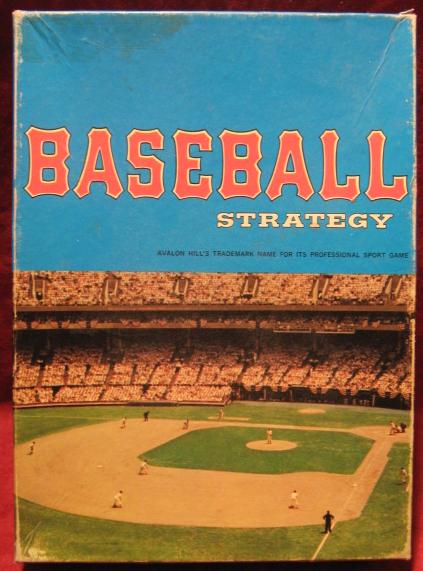
Strat-O-Matic has its competitors, the most popular of which might be APBA. Avalon Hill also produced baseball board games. Way back in ’62 they came out with Baseball Strategy. It uses “Fast Action” cards instead of dice to randomly determine outcomes. I recently picked up a much later version that AH released in 1980. Here are some scans if anyone's curious.
I’ve been been tossing around some of my own ideas for a baseball board game - admittedly much less simulation and much more gonzo. It’s a mash up of D&D and basic baseball rules, something I call Goblinball. I first began thinking about it when I attempted to improvise a game during one of our regular S&W sessions. That didn’t quite go the way I’d expected when the party brazenly attacked the hitter and catcher and all hell broke loose from both bullpens. I'd expected that to eventually happen, but hoped there’d be some bets and baseball drama first (bad calls, taunting, hit by pitches, etc.)
What’s interesting to me about the process of trying to hack them together is realizing how much they already remind me of one another. There’s the battle between pitcher and hitter, with each side “rolling” to see if they succeed against the other. There’s the saving throw of the defensive players who must catch the ball or tag the runner out, or perhaps dexterity checks on either side to accomplish their aims (or skills if you must).
The flow of a baseball game reminds me of D&D. A typical game can last hours, and occasionally goes longer than anyone expected (without a set end time). The storytelling is something like each person briefly becoming a radio broadcaster and relaying the game action. The DM is both pitcher and umpire, throwing the group various curveballs. I like how everyone has their own moment to shine when at bat; each individual describes his character’s action and makes a combat or other type of roll. When the party is in the field, they’re shouting defensive information and advice.
Describing and simulating actions in baseball and D&D also seem similar because of the limits of the field of play itself. In baseball, you can’t stray from the running lane and must move through the bases to score. It’s exactly this structure that makes the game easier to simulate. We don’t need to explain how the player goes to first, the player just indicates what his move is and we both make assumptions. He doesn’t have to describe every step - we both understand that there’s only one place to go and that the critical move was made a moment ago. The pitch and bat swing is analogous to the “What does your character do?” and “I do this.” exchange. In other words, it’s a linear, storytelling game.
Compare this for example to soccer (another game I enjoy)… Imagine describing the action in detail here. Sure it can be done, but it's painful: number 14 receives the ball, she dribbles 10 feet west, turns 30 degrees and moves a few feet forward, now back 4 feet, etc. The playing field is literally a field, whereas the baseball field is a field of probability and a track.
Hmmm, maybe I’m not describing that quite right. How about this: the randomness and uncertainty of a soccer ball or player’s location at any given moment is much higher than what can similarly be found in baseball. It’s this greater certainty principle in baseball that allows us to better design tools to simulate and measure the actions that happen there. D&D is a more linear game, based on the nature of back and forth discourse that moves the action forward. We aren’t all moving forward together in that field, we’re generally waiting for one described action to inform the next.
Just some pre-beer/game thoughts - in closing: Go Tigers!
Update: Facepalm.
Labels:
Other Games/Genres,
Theory/Design
Subscribe to:
Posts (Atom)